What HR software costs in 2026
HR software runs $5 to $25 per employee monthly on published plans. Rippling, HiBob, and Workday are quote-only. Here's what six vendors charge.
The HR software cost breakdown, vendor by vendor
HR software cost ranges from $5 a month per employee for a bare-bones HRIS to several hundred dollars per employee once payroll, benefits, or employer-of-record services get added. Some vendors publish real numbers on their pricing pages. Others, like Rippling, HiBob, and Workday, quote every deal individually, so the number a sales rep opens with rarely matches your final bill.
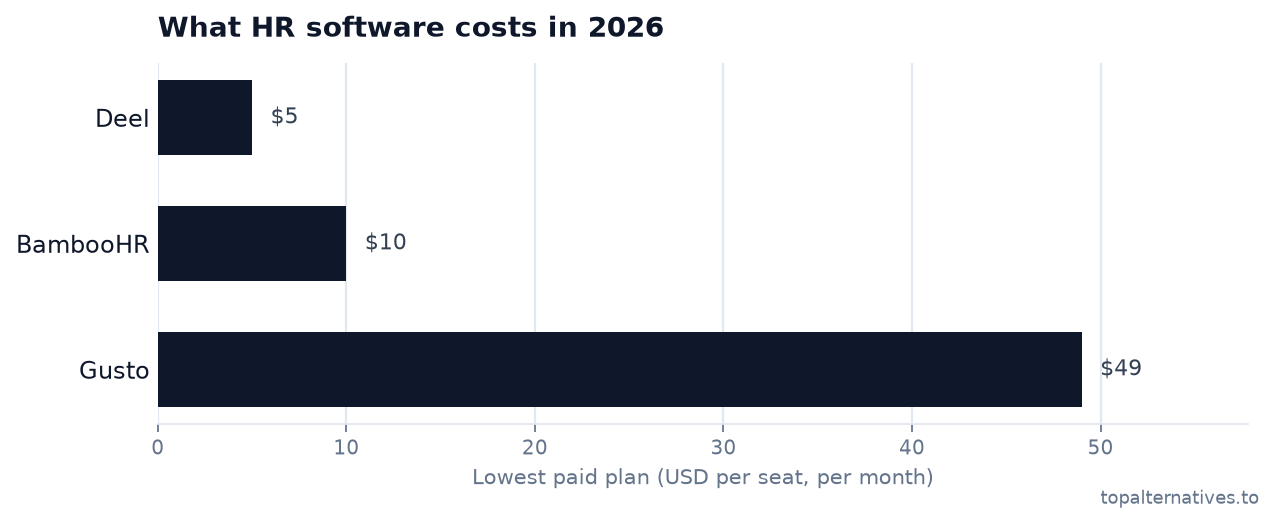
The table below covers six HR and HCM vendors, checked against each one's own pricing page on July 6, 2026.
| Tool | Cheapest published price | Priced per | Published or quote-only | What's included at that price |
|---|---|---|---|---|
| Gusto | $49/mo base + $6/mo per person (Simple) | seat, plus flat base fee | Published | Single-state payroll, unlimited runs, tax filing |
| BambooHR | $10/employee/mo (Core) | seat | Published tiers, quote to buy | HR data, hiring, onboarding, time off |
| Deel | $5/employee/mo (Core HR) | seat | Published | Worker profiles, time off, compliance insights |
| Rippling | No published price | seat, per module | Quote-only | Depends entirely on modules selected |
| HiBob | No published price | seat, per module | Quote-only | Depends on headcount and modules |
| Workday | No published price | seat, per module | Quote-only | Depends on modules and implementation scope |
Every figure in that table is pulled straight from the vendor's own site, checked July 6, 2026. Get your own quote before you sign anything. A negotiated enterprise deal on any of these six won't match the list price above. Note also that the three published prices are not shaped the same way: Deel and BambooHR quote a flat per-seat rate, while Gusto layers a per-person charge on top of a fixed monthly base. That difference is why Gusto looks the most expensive in the chart above but behaves very differently once you put a real headcount into the equation.
Why three of the six won't tell you a price
Rippling, HiBob, and Workday all use the same playbook: no dollar figures on the site, just a form that leads to a sales demo. Rippling's own FAQ confirms it bills per employee per month, with each module, payroll, benefits, device management, spend management, sold separately on top of a required base platform. HiBob's pricing page says cost depends on headcount and which modules you pick, from Core HR to the newer Bob Finance module, then routes you to a quote request. Workday doesn't even have a general pricing page; workday.com/en-us/pricing.html returns a 404, and the only path to a number is a sales contact form. None of these three publish a starting price we can verify, so treat any number you see elsewhere as a third-party estimate, not a vendor-confirmed figure.
Outside the six in the table, SAP SuccessFactors works the same way; its recruiting pricing page routes to a contact form rather than a published rate, checked the same day. The hidden cost of quote-only pricing is calendar time. Budgeting for one of these means budgeting for a discovery call, a demo, a scoping conversation about which modules you actually need, and usually a security or procurement review before a number lands in writing. Quote-only vendors also tend to price against annual commitments and headcount bands rather than a live seat count, which means shrinking mid-term rarely shrinks the invoice. If you need a defensible cost figure this month, the published-price vendors are the only ones that can give you one.
The base-fee-plus-seat trap
Gusto's plans look cheap until you separate the base fee from the per-person charge. Simple is $49 a month plus $6 a month per person, so a 20-person company pays $169 a month, not $49. Move to Plus for multi-state payroll and the math changes again: $80 a month plus $12 a month per person puts that same 20-person team at $320 a month. Gusto also raised the Simple plan's base fee from $40 to $49 in March 2026, narrowing its price edge over cheaper competitors. Read every per-employee number as one part of two, not the whole bill.
The base fee punishes the smallest teams hardest, because a handful of employees splits that fixed charge across very few people. By the time you hit 20 employees on Simple, the per-person portion already outweighs the base fee, and from there the flat charge stops mattering much. The reverse is true of the tier jump: upgrading from Simple to Plus raises both the base fee and the per-person rate at the same time, so the increase compounds with headcount instead of being a one-off.
Add-ons that aren't in the sticker price
Core HR software rarely covers everything a company needs, and the gaps get filled by paid add-ons that don't show up in the headline number.
- Payroll. BambooHR sells payroll as a separate add-on outside its three published tiers, and it's US-only. Gusto bundles payroll into every base plan, but multi-state payroll specifically requires upgrading from Simple to Plus.
- Benefits administration. Gusto includes health insurance and 401(k) administration in its core plans, but priority support and the HR resource center are separate add-ons even on Plus. BambooHR's benefits administration is also priced outside its Core, Pro, and Elite tiers.
- Employer of record (EOR). Deel's EOR product, for legally employing full-time staff in a country where you have no entity, costs $599 to $899 per employee per month, far above its $5 Core HR price. Gusto's equivalent, Gusto Global, covers only 12 countries and doesn't appear as a line item until you need it.
- Modules on modular platforms. Rippling and HiBob both charge per module on top of a base platform or headcount fee. A Rippling quote that starts low can grow fast once payroll, benefits, and IT device management are all switched on.
- Implementation and migration. Enterprise-grade suites like Workday and SAP SuccessFactors scope implementation separately from subscription, so the per-seat rate you negotiate is not the number you pay in year one.
What the entry tier actually stops covering
Every published entry price in this comparison buys a deliberately narrow product, and the boundary is usually payroll. Deel's $5 Core HR tier is an HR record system, not a way to pay anyone; contractor management, global payroll, contractor-of-record, and EOR are all priced on separate lines. BambooHR's $10 Core tier covers HR data, hiring, onboarding, and time off, but payroll and benefits administration sit outside the tier structure entirely, so a company that wants the full stack is never really paying $10. Gusto's Simple plan is the opposite trade: payroll and tax filing are included from the start, but only in a single state, and a second state forces the Plus upgrade at $80 a month plus $12 per person.
The practical test is to write down every process you expect the software to run, then check which of them the cheapest tier names explicitly. Performance reviews, advanced reporting, priority support, and multi-country hiring are the four that most often live one tier up or one add-on across. If three of your must-haves sit outside the entry plan, the entry price is not your price and comparing it against a rival's all-in quote will mislead you.
What actually drives the bill up as you grow
Headcount is the obvious lever, since every vendor here charges per employee in some form. The less obvious lever is how many modules or add-ons you end up needing. A 50-person company running just core HR and payroll on Gusto or BambooHR pays a predictable, mostly flat number. The same company running Rippling with payroll, benefits, IT device management, and spend management turned on is paying for four separate line items that don't show up until the quote is built. Deel's model makes this explicit with distinct price lines for HR, contractor management, contractor-of-record, global payroll, and EOR, each billed on its own.
The shift between a 20-person team and a 50-person one is less about the per-seat rate and more about what the company starts needing. At 20, a flat base fee still shows up on the invoice and a single-state payroll plan often holds. By 50, the fixed base has faded into rounding, but multi-state payroll, structured performance reviews, and real reporting usually push you up a tier, which is where BambooHR's spread between its $10 and $25 rates bites. Larger headcount also changes the conversation with the quote-only vendors: they take the call sooner, and you have more leverage on a multi-year deal than a small team ever will.
Who each tool actually fits
A small, US-only business that wants payroll and tax filing handled without a sales call pays least on Gusto, starting at $49 a month plus $6 per person. A company that wants published pricing plus stronger hiring and onboarding tools fits BambooHR better, at $10 to $25 per employee a month depending on tier. A company hiring full-time staff outside the 12 countries Gusto Global supports needs Deel's EOR product, at $599 to $899 per employee a month, a real cost jump but one with no legal-entity setup required. Companies that want HR tied to IT device management and spend control, or that want an enterprise system spanning HR and finance, will end up quote-only on Rippling, HiBob, or Workday regardless of budget, so build in time for a sales cycle before you get a real number.
Who each tool is wrong for
The fastest way to shorten this shortlist is to rule tools out on structure rather than price. Gusto is wrong for a company with employees in several countries, since its payroll strength is US-focused and Gusto Global reaches only 12 countries. BambooHR is wrong for a buyer who wants one vendor and one invoice covering HR, payroll, and benefits, because payroll and benefits administration are priced outside the Core, Pro, and Elite tiers and payroll is US-only. Deel's $5 Core HR tier is wrong for a US-only team that mainly needs payroll and benefits under one roof, because the cheap tier does not include them and the pieces that do are billed separately.
On the quote-only side, Rippling and HiBob are wrong for anyone who needs a firm budget number before they will take a demo, and Rippling in particular is a poor fit if you only want the HR module, since its value case rests on stacking payroll, benefits, device management, and spend management on one platform. Workday and SAP SuccessFactors are wrong for a small team full stop; both are built for scope and implementation depth that a company running lean payroll will never use and should not pay for.
If Gusto or Rippling is the tool you're currently paying for and rethinking, our Gusto alternatives ranking and Rippling alternatives ranking dig into how the rest of this field stacks up against each one specifically.
Keep reading
FAQ
Why won't Rippling, HiBob, or Workday show a price?+
All three sell modular platforms where the total depends on headcount and which modules you turn on, so each treats pricing as a custom quote rather than a fixed list price. Rippling's FAQ confirms billing is per employee per month per module. HiBob's pricing page routes buyers straight to a quote request. Workday has no general pricing page at all, only a sales contact form.
What's the cheapest published HR software price?+
Deel's Core HR module lists at $5 per employee per month, the lowest published price among these six, but it's a bare HR layer without built-in payroll. BambooHR's Core plan at $10 per employee per month is the cheapest option that pairs core HR with an add-on payroll path.
Does HR software charge extra for payroll?+
It depends on the vendor. Gusto bundles payroll into every base plan, though multi-state payroll requires upgrading from Simple to Plus. BambooHR sells payroll as a separate, US-only add-on outside its three published tiers. Deel sells payroll as its own product line, separate from Deel HR.
How much does it cost to hire a full-time employee in another country?+
Through an employer-of-record service, Deel's EOR plans run $599 to $899 per employee per month depending on the tier. Gusto's equivalent, Gusto Global, is limited to the US plus 12 countries rather than Deel's 110+, and doesn't list a separate EOR price outside its core plans.
Sources
Should your product be on this list?
If you build a tool that belongs next to the ones above, submit it. A human reviews every submission. Approved products get their own page with pricing and screenshots, plus a place in the comparisons where they fit. It is free. You sign in with your work email so you can follow the decision, and there is no password to create.
Spotted something wrong or out of date? Report it and we'll check it against the source.