Top Close Alternatives in 2026
Here for Close itself? See the full Close profile, pricing & reviews →
Suggest a change- If you want a real free CRM to start before committing to a paid seat, choose HubSpot. HubSpot's Free CRM plan has no time limit and needs no credit card, while Close only offers a 14-day trial with no free tier at all.
- If you're standardizing a larger sales org and need deep customization, custom objects, or an AI agent framework built on live CRM data, choose Salesforce. Salesforce's Agentforce and Apex-level configuration go further than anything in Close, though you'll likely need an admin to set it up.
- If you want a fast visual pipeline for reps without paying extra for calling minutes, choose Pipedrive. Pipedrive's seat price already includes its AI Sales Assistant and doesn't add per-minute calling charges on top the way Close does.
- If you want CRM automation and forecasting at the lowest per-seat price and don't need a marketing hub, choose Zoho CRM. Standard tier costs $14 a seat a month and already includes workflow automation that Close reserves for its $99-a-seat Growth plan.
- If your team runs high volume outbound calling and wants dialing, SMS, and email logged straight to the lead record in one product, choose stay on Close. No alternative on this list bundles a native power and predictive dialer into the CRM record the way Close does, so switching usually means adding a separate calling tool.
Close bundles calling, SMS, and email into one CRM built for small sales teams doing outbound work. But there's no free tier, the 1-user Solo plan means real teams jump straight to the $35-a-seat Essentials tier, and calling minutes bill separately on top of the seat price. Teams that don't need a built-in dialer, or that want a free CRM to start, often look elsewhere.
The four alternatives below are all CRMs built for outbound sales teams, the kind of tool a Close buyer would actually cross-shop, though HubSpot, Salesforce, and Zoho CRM are also the flagship CRM product inside a much broader platform. HubSpot and Zoho CRM offer a genuine free tier. Salesforce covers the high end for teams that need deep customization. Pipedrive matches Close's focus on a fast sales pipeline without the calling add-on costs, and comes closest to Close's sales-first scope.
Close alternatives compared
| Tool | Best for | Starting price | Free option | Last update |
|---|---|---|---|---|
| HubSpotBest free option | Growing companies that want marketing, sales, and support data in one system instead of stitching together separate point tools | $7/seat/mo | Yes | June 2026 |
| SalesforceBest for enterprise | Mid-market and enterprise sales teams that need deep customization, complex approval workflows, or industry-specific data models | $25/seat/mo | Yes | June 2026 |
| Pipedrive | Small and mid-sized B2B sales teams that want a fast, visual pipeline without a heavy admin setup | $14/seat/mo | Trial (14 days, full access to the selected plan, no credit card required) | June 2026 |
| Zoho CRMBest value | Small and mid-size sales teams that want automation, forecasting, and AI features without paying enterprise-tier prices | $14/seat/mo | Yes | June 2026 |
Why teams switch from Close
No free-forever plan
Close only offers a 14-day trial and a 30-day money-back guarantee. There's no free tier to fall back on the way HubSpot and Zoho CRM both offer.
The Solo plan caps at 1 user
The $9-a-seat Solo plan is capped at a single user and 10,000 leads, so almost any real team has to jump straight to the $35-a-seat Essentials tier.
Calling costs bill separately from the seat price
Outbound calling runs about $0.02 a minute and phone numbers cost roughly $1 a month each, on top of the seat price, so the real monthly bill runs higher than the sticker price for call-heavy teams.
AI usage is metered by monthly credit
Chloe's usage is capped by a monthly AI credit allowance per plan, from 500 to 2,000 credits, so heavy users can rack up extra usage charges beyond the seat price.
The best Close alternatives, ranked
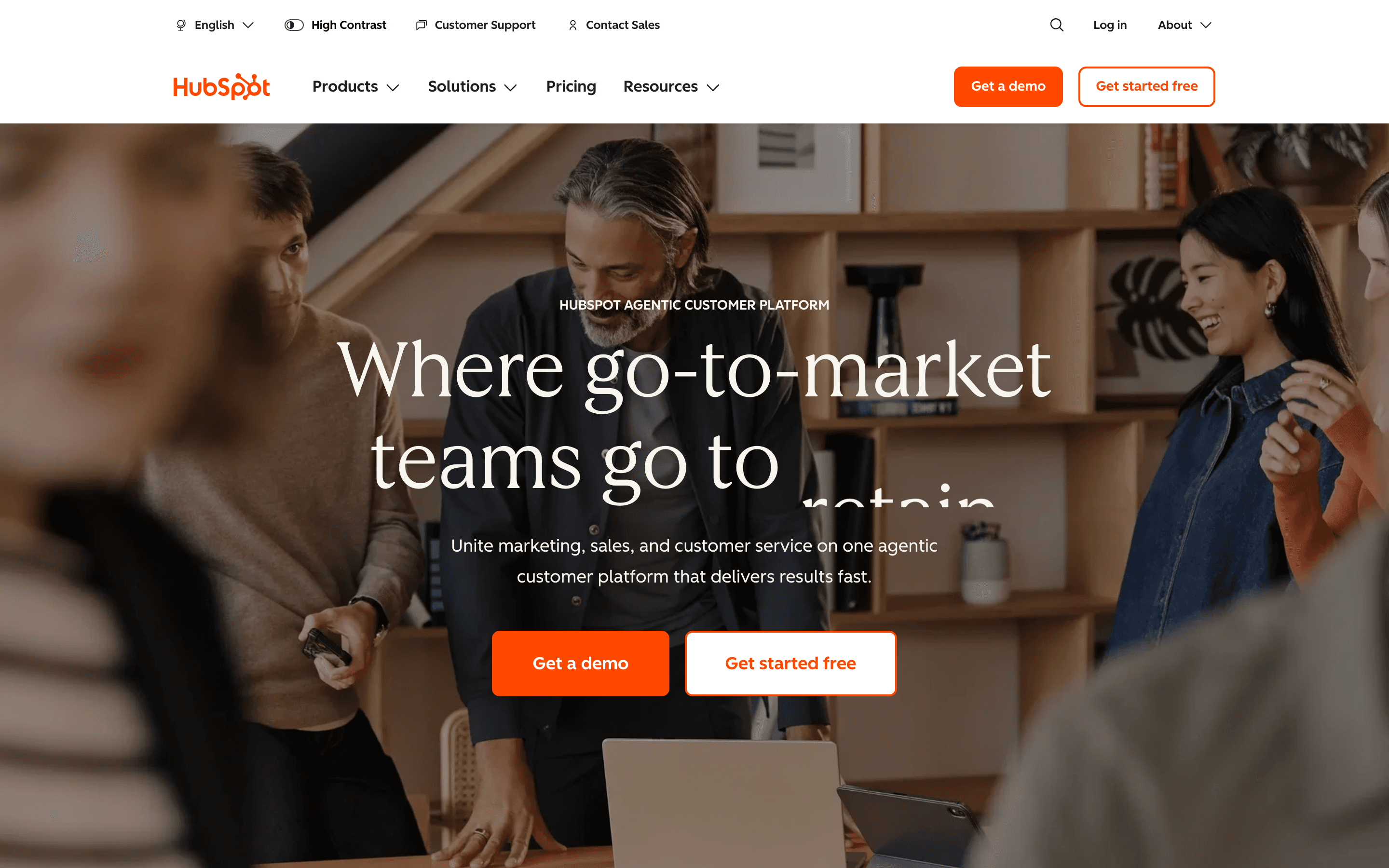
HubSpot is the pick for teams that want a free CRM before paying anything, something Close doesn't offer at all. The Free CRM plan covers 2 users and includes contact, deal, and task management with no expiration date and no credit card required, while Close's cheapest option is a 14-day trial. Once you need real automation, HubSpot's Starter Customer Platform starts around $7-20 a seat a month, still cheaper at the low end than Close's $35-a-seat Essentials tier.
The tradeoff shows up in outbound sales tooling. HubSpot's calling and sequencing live inside Sales Hub, not built into the base plan the way Close's dialer and SMS are, and Professional and Enterprise tiers add one-time onboarding fees from $1,500 to $7,000. Teams whose sales motion is mostly outbound calling will find Close's native dialer a tighter fit than HubSpot's broader, marketing-first platform.
Pros
- + One contact record shared across marketing, sales, and service cuts down on duplicate data entry
- + The free CRM plan has no time limit and needs no credit card to start
- + A large ecosystem of native integrations and a marketplace of third-party apps
Cons
- – Marketing Hub pricing tracks marketing contact volume, so costs can rise as your list grows even without adding seats
- – Professional and Enterprise tiers on Sales and Marketing Hub carry separate one-time onboarding fees, from $1,500 to $7,000 depending on hub and tier
Salesforce is the choice once a sales org outgrows anything Close or HubSpot offer in customization. Its free Suite caps at 2 seats, and paid Sales Cloud tiers run from a self-serve $25-a-seat Starter Suite up to $550-a-seat Agentforce 1 Sales, versus Close's top Scale tier at $139 a seat. Custom objects, Apex-level configuration, and Agentforce AI agents built on live CRM data go well beyond what Close's Chloe assistant or workflow automation cover.
That depth costs more than money. Only Starter Suite bills monthly. Pro Suite and above are annual-only, and most Enterprise-tier rollouts need an in-house admin or implementation partner, a setup cost Close's self-serve model doesn't require. Choose Salesforce if you're building a sales org for years, not if you want to start calling leads the day you sign up.
Pros
- + Deep customization: custom objects, fields, page layouts, and Apex code cover almost any sales process
- + The largest third-party ecosystem of any CRM (AppExchange/AgentExchange), so most niche needs already have an integration or app
- + Agentforce lets teams build AI agents, like SDR-style lead qualification bots, directly on existing CRM data without a separate AI platform
Cons
- – Only the entry-level Starter Suite offers monthly billing; Pro Suite and every tier above it are billed annually only, with no published month-to-month rate
- – Real-world cost climbs fast once you need the full AI suite or industry clouds: Agentforce and Conversation Intelligence start at Enterprise ($175/user/month), but unmetered Agentforce usage, Predictive AI, and Sales Engagement need Unlimited ($350) or the $550/user/month Agentforce 1 Sales edition
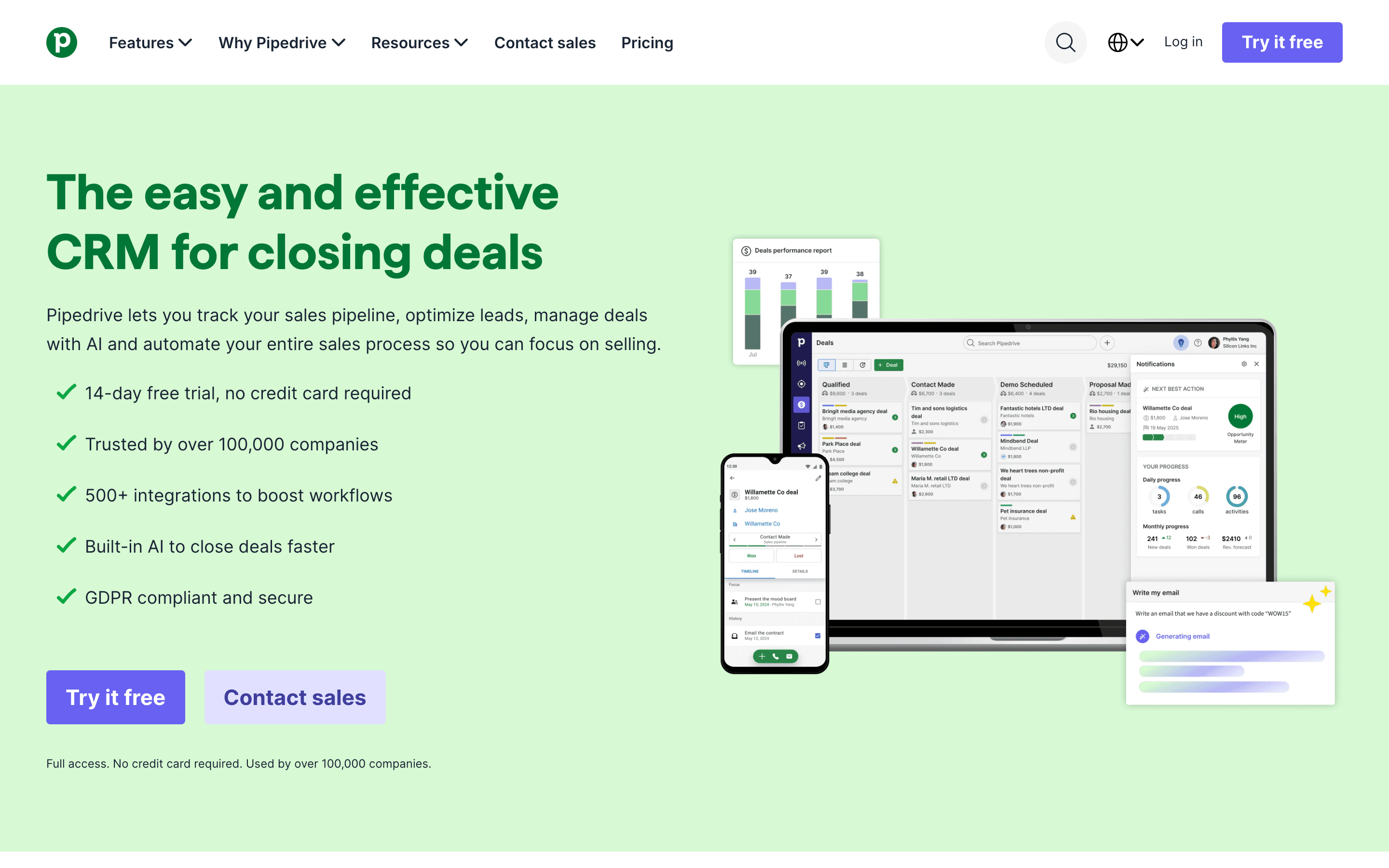
Pipedrive shares Close's focus on outbound sales activity but skips the built-in dialer entirely. Its Lite plan starts at $14 a seat a month, cheaper than Close's $35-a-seat Essentials tier, and includes an AI Sales Assistant from the entry tier. A native MCP server, added in June 2026, lets any plan connect deals and contacts to AI assistants like Claude or ChatGPT.
The gap is calling. Close logs every call and text straight to the lead record with a native power and predictive dialer. Pipedrive has no dialer of its own, so teams need a separate calling tool layered on top. Two-way email sync also isn't available on Pipedrive's entry Lite plan, only one-way Smart BCC logging, and LeadBooster's lead generation tools cost extra unless you're on Premium or Ultimate.
Pros
- + The pipeline UI is fast to set up and easy for reps to learn with little training
- + AI Sales Assistant and AI-generated reports are included on the entry plans too, not held back for the top tier
- + 500+ marketplace integrations, plus a native MCP server added in June 2026 for connecting CRM data to ChatGPT and Claude
Cons
- – No permanent free plan, unlike some CRM competitors
- – Core revenue-generating features like LeadBooster's chatbot, live chat, and prospecting tools, plus Smart Docs and Campaigns, cost extra unless you're on Premium or Ultimate
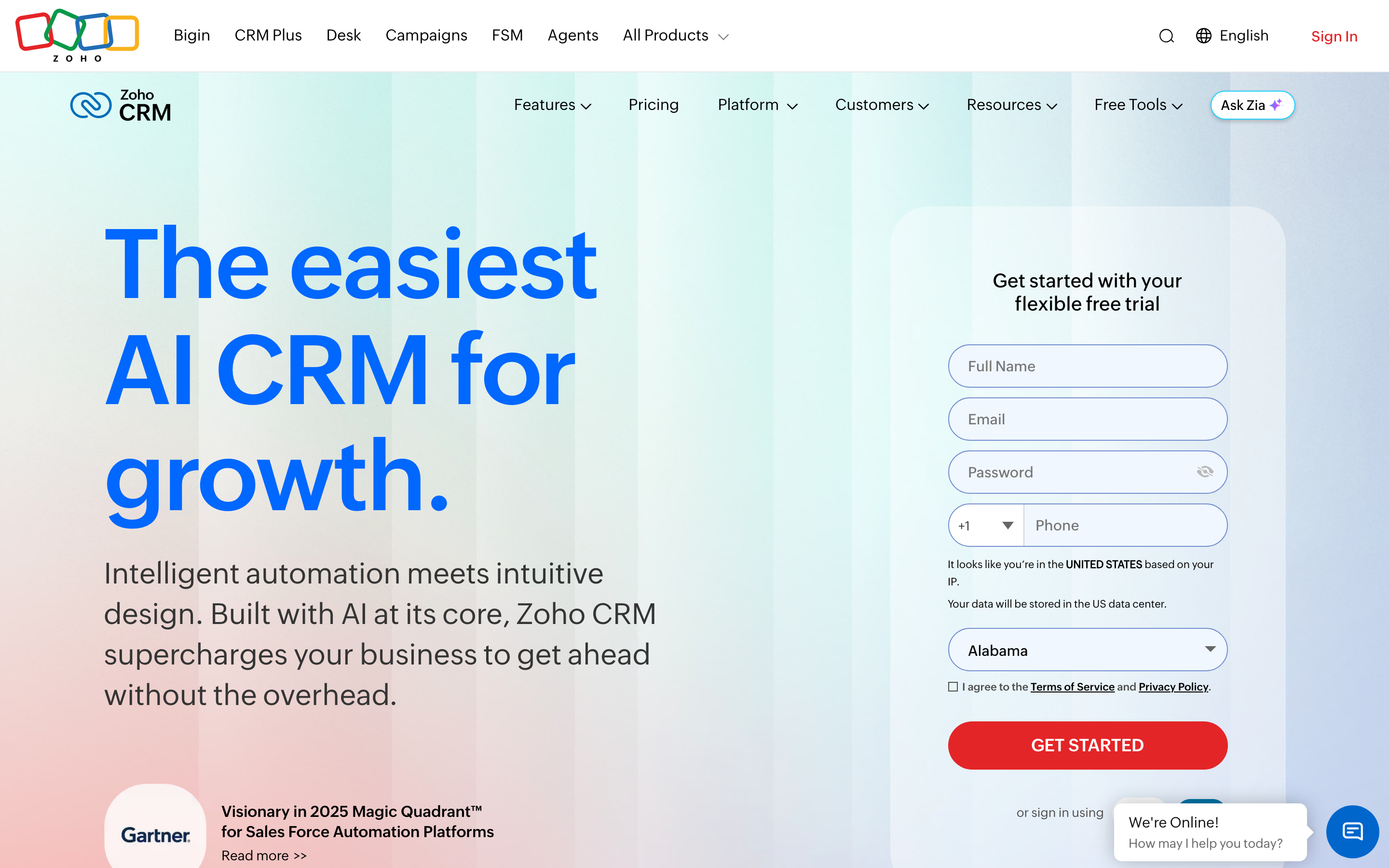
Zoho CRM undercuts Close on price at every tier while adding a free plan Close doesn't have. Standard costs $14 a seat a month and already includes workflow automation, a feature Close doesn't unlock until its $99-a-seat Growth plan. Zia, Zoho's AI assistant, along with territory management, arrives at Enterprise ($40 a seat) with no extra add-on fee, and the free plan covers 3 users versus Close's zero.
What you give up is calling depth and interface polish. Zoho's admin screens are widely described as dense next to Close's cleaner design, and its native telephony isn't built to the same standard as Close's dialer. For teams that want CRM automation on a budget and don't need Close-grade calling, Zoho CRM is the stronger value play.
Pros
- + Automation (workflow rules, Blueprint process flows) and sales forecasting are available starting on the Standard tier, not gated to the top plan
- + Zia AI assistant, journey orchestration, and territory management are included from the Enterprise tier with no extra add-on fees
- + Free forever plan for up to 3 users covers basic pipeline and contact management
Cons
- – Interface and admin/settings screens are widely reported as dense and dated compared with HubSpot or Pipedrive
- – CPQ, inventory management, and custom portals require moving up to Professional or Enterprise, adding cost as teams grow
Should your product be on this crm & marketing list?
If you build a tool that belongs next to the ones above, submit it. A human reviews every submission. Approved products get their own page with pricing and screenshots, plus a place in the comparisons where they fit. It is free. You sign in with your work email so you can follow the decision, and there is no password to create.
Close alternatives: FAQ
What's the cheapest Close alternative with a real free plan?+
HubSpot's Free CRM plan covers 2 users with contact, deal, and task management, no time limit, and no credit card required. Zoho CRM's free plan covers 3 users with basic contact management and workflow automation. Close has no free tier at all, only a 14-day trial.
Does any Close alternative match its built-in calling and dialer?+
Not directly. None of these alternatives ship a native power or predictive dialer the way Close does. Pipedrive has no dialer of its own, and HubSpot's calling and sequencing live inside the paid Sales Hub rather than the base plan. Teams that rely on Close's dialer should expect to add a separate calling tool if they switch.
Which Close alternative is best for a larger, more complex sales org?+
Salesforce, once you're past its 2-seat free tier and into Enterprise ($175 a seat) or above, offers the deepest customization and the largest third-party app marketplace of any option here.
I mainly want to save money on CRM seats. What should I switch to?+
Zoho CRM's Standard tier costs $14 a seat a month, well under Close's $35-a-seat Essentials plan, and already includes workflow automation.
Close alternatives: pricing compared
Entry price, billing model, and whether pricing is public. 5 of 5 publish pricing you can check without talking to sales.
| Tool | Starting price | Billing | Free option | Pricing disclosed |
|---|---|---|---|---|
| Close | $9/seat/mo | per-seat | Trial (14 days, no credit card required) | Public |
| HubSpot | $7/seat/mo | tiered | Yes | Public |
| Salesforce | $25/seat/mo | per-seat | Yes | Public |
| Pipedrive | $14/seat/mo | per-seat | Trial (14 days, full access to the selected plan, no credit card required) | Public |
| Zoho CRM | $14/seat/mo | per-seat | Yes | Public |
How we made these picks. We compare tools on public pricing, features, and hands-on assessment, then verify every price against the vendor's own page. We never accept payment for rankings. Read the full methodology. Spotted an error? Report it.
More crm & marketing comparisons
Further reading
- How to switch from Close to Pipedrive - Pipedrive Lite is cheaper than Close Essentials and skips per-minute calling fees, but you lose the built-in dialer. Here's how the switch works.