Top Lusha Alternatives in 2026
Here for Lusha itself? See the full Lusha profile, pricing & reviews →
Suggest a change- If you also want outreach sequencing bundled with your contact database, or a dialer if you're willing to pay for Professional, choose Apollo. Apollo's Basic plan starts at $49 per seat per month, but that price requires an annual commitment; Apollo's own pricing page says annual billing saves 24% versus paying monthly, which puts the real month-to-month rate around $64-65 per seat, well above Lusha's $49.90 Starter price with no annual lock-in. Apollo still adds unlimited sequences and CRM integrations on top of database access, though the dialer only shows up on Professional at $79 per seat per month billed annually.
- If you like how Lusha works but keep hitting its roughly 25-contact bulk session cap, choose Prospeo. Prospeo runs the same credit-based pricing shape as Lusha but raises the row-selection limit to 20,000 and adds native HubSpot and Salesforce sync on its Growth and Pro plans.
- If you're an enterprise team that needs buyer intent data and a bigger, more frequently refreshed database and you have budget for a negotiated contract, choose ZoomInfo. ZoomInfo bundles intent signals and Chorus conversation intelligence that Lusha doesn't offer, though every paid plan is quote-only and real contracts commonly run into five figures a year.
- If your real problem is enriching a list you already have, not finding new leads, and you want the cheapest possible entry price, choose BetterContact. BetterContact starts at $15 a month for 200 credits and only charges for verified hits across more than 20 data providers, undercutting Lusha's $49.90 entry tier.
- If you're a small team that mostly needs email addresses, already has the browser extension in daily use, and wants published self-serve pricing without learning a new tool, choose stay on Lusha. Lusha's Starter plan is priced for email-heavy workflows and switching costs from retraining reps and re-integrating a CRM can outweigh the marginal gains most alternatives offer.
Lusha built a name selling verified emails and phone numbers through a browser extension and a simple credit system, priced low enough that sales and RevOps teams could try it without a sales call. Teams outgrow it in a few predictable ways: bulk enrichment sessions cap out around 25 contacts per session, phone reveals cost 10x an email in credits, and some reviewers flag data freshness and accuracy gaps, especially on phone numbers.
The alternatives below cover different reasons to switch. Prospeo runs almost the identical credit model with more room to enrich in bulk and native CRM sync. Apollo and ZoomInfo bundle in outreach sequencing or buyer intent for teams that want more than a database. BetterContact only enriches a list you already have; Clay does that too but is also used to build and source new prospect lists through its waterfall and AI-agent workflows.
Lusha alternatives compared
| Tool | Best for | Starting price | Free option | Last update |
|---|---|---|---|---|
| ApolloBest for teams that also need outreach | Teams that want prospecting data, enrichment, and outreach sequencing in one subscription instead of stitching together a data provider and a separate sender | $49/seat/mo | Yes | June 2026 |
| ProspeoBest like-for-like upgrade | Sales and RevOps teams enriching CRM exports or CSV lead lists with verified emails and firmographics | $49/seat/mo | Yes | — |
| ZoomInfoBest for enterprise scale | Mid-market and enterprise sales orgs that need a large, frequently refreshed contact database with org charts and direct dials | Free tier + custom | Yes | June 2026 |
| BetterContact | Sales and RevOps teams that already have a list of leads or accounts and need emails and phones filled in, not a new prospecting database | $15/mo | Trial (50 free credits on signup) | — |
| Clay | RevOps and growth teams that need to combine data from many providers into one enriched record | $185/mo | Yes | June 2026 |
Why teams switch from Lusha
Bulk enrichment sessions cap out around 25 contacts at a time
Teams doing bulk enrichment run into per-session extraction limits, which slows down large list-building work.
Data freshness and accuracy gaps on some records
Some reviewers flag data freshness and accuracy gaps, saying the database relies on outdated information in places, particularly on phone numbers.
Phone number reveals cost 10x an email reveal
Phone-heavy prospecting workflows burn through a credit allowance much faster than email-only workflows, since a phone reveal costs 10 credits against 1 for an email.
No free trial on paid plans
Lusha offers no time-limited trial above the Free plan, only the 40-credit-a-month Free tier to test the product before buying.
The best Lusha alternatives, ranked
Apollo is the most direct step up from Lusha if your team also runs outreach, not just enrichment. Its Basic plan starts at $49 per seat per month, but only if you commit to annual billing; Apollo says annual billing saves 24% versus paying monthly, which puts the true month-to-month rate around $64-65 per seat, about 30% more than Lusha's $49.90 Starter price with no annual commitment. For that price Apollo bundles unlimited sequences, CRM integrations, email warmup, and 30,000 credits per seat per year. The free plan gives full access to the 230M+ contact database rather than a stripped demo. The catch is the same one Lusha has: credits meter email and phone reveals separately, 1 credit for an email and 8 for a phone, so heavy users can burn through the annual allotment fast. Apollo also charges extra for the international dialer and website visitor tracking. For teams that want data plus sequencing and a dialer in one subscription instead of stitching Lusha to a separate outreach tool, Apollo is the closer fit.
Pros
- + Free plan gives full access to the contact database, not just a limited sample
- + Combines data, enrichment, sequences, and a dialer in one product instead of three separate subscriptions
- + Credits are granted upfront for the year on annual plans rather than trickled out monthly
Cons
- – Credit system means the advertised seat price understates real cost for active users who unlock a lot of emails and phone numbers
- – Organization plan has a 3-seat minimum, pushing its real entry cost to at least $357/month even at the lowest advertised per-seat rate
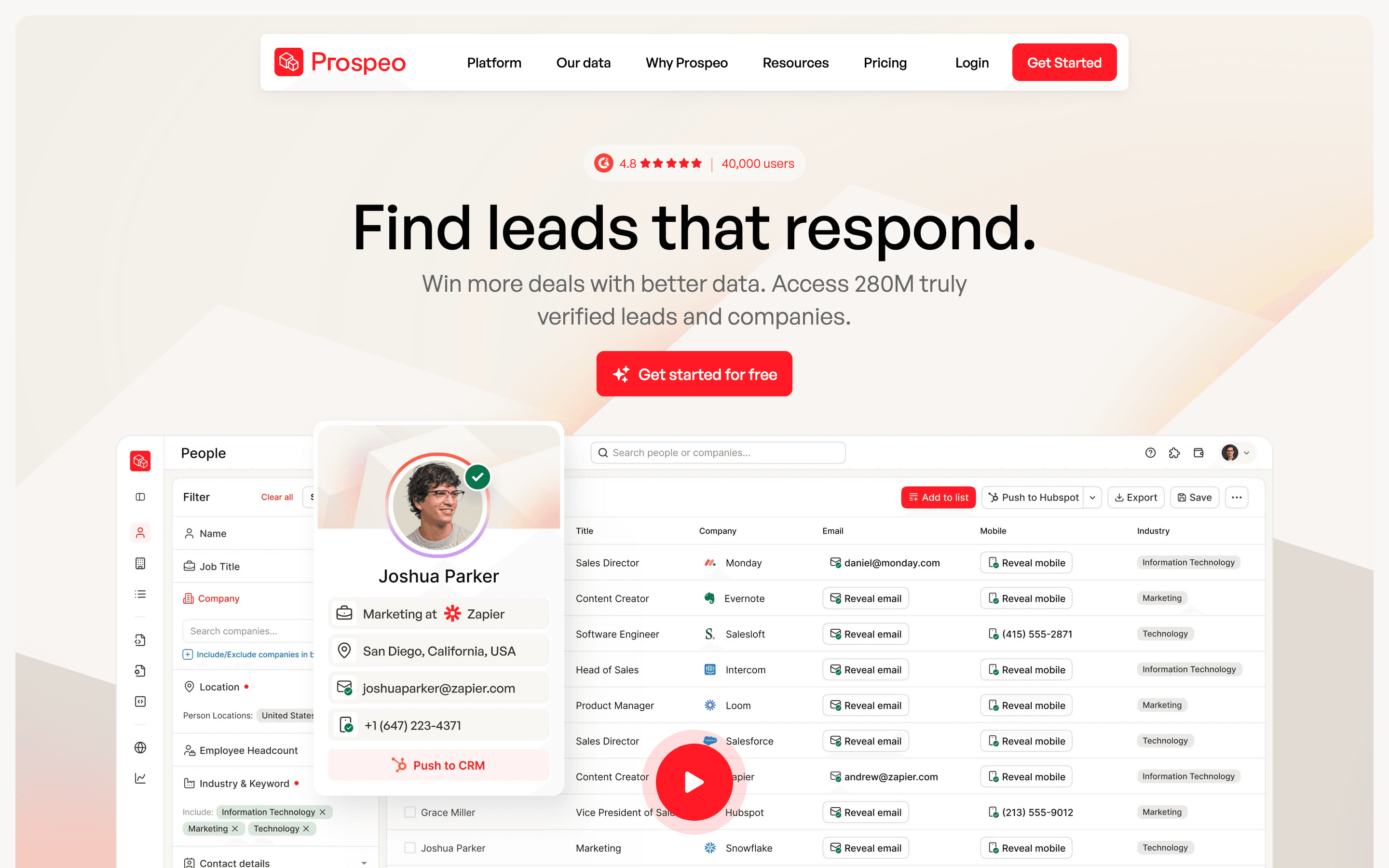
Prospeo mirrors Lusha's pricing shape almost exactly, free through Pro tiers, 1 credit per verified email and 10 per mobile number, self-serve with no sales call needed, which makes it the easiest like-for-like swap. Where it pulls ahead is scale and integration depth: paid plans allow up to 20,000 rows per selection versus Lusha's roughly 25-contact bulk sessions, and Growth and Pro add native HubSpot and Salesforce sync rather than requiring a browser extension workflow. The free plan has no time limit and still includes the Chrome extension and AI Search. The tradeoff is the same phone-credit math as Lusha, mobile reveals cost 10x an email, so phone-heavy prospecting still drains credits quickly on either tool. For a team that likes how Lusha works but wants more room to enrich in bulk, Prospeo is the closest match.
Pros
- + Published, self-serve pricing for every plan from Free through Pro, no contact-sales gate to see numbers
- + Unused credits roll over every cycle instead of expiring, on both monthly and yearly billing
- + Free plan has no time limit and includes the Chrome extension and AI Search, not just a stripped demo
Cons
- – Mobile number reveals cost 10 credits versus 1 for an email, so phone-heavy workflows burn through a plan fast
- – Row selection is capped at 20,000 even on paid plans below custom add-ons, which limits single-batch bulk exports
ZoomInfo is the upgrade path for teams that outgrow what a credit-based, self-serve tool like Lusha can offer. It layers buyer intent signals, org charts, and Chorus conversation intelligence on top of a larger, more frequently refreshed database, and its Copilot layer surfaces buying signals directly inside Salesforce or HubSpot. None of that comes with a published price: every plan above the free ZoomInfo Lite tier is quote-only, and Vendr's aggregated purchase data puts the median real-world contract around $33,500 a year, far above Lusha's self-serve pricing. The free ZoomInfo Lite plan gives only 10 monthly contact credits, useful for a spot check but not for real prospecting volume. ZoomInfo makes sense once a team needs intent data and enterprise-grade breadth and has budget and time for a sales negotiation, not for a team that just wants Lusha's job done more cheaply.
Pros
- + One of the largest and most frequently updated B2B contact and company databases on the market
- + Buyer intent data and Copilot signals help reps prioritize accounts instead of cold-calling a flat list
- + Bundles data, conversation intelligence (Chorus), and workflow automation under one vendor
Cons
- – No public pricing above the free tier; every paid plan requires a sales call and custom quote
- – Real-world annual contracts commonly land far above the entry list prices vendors quote in marketing, once seats, credits, and add-ons are included
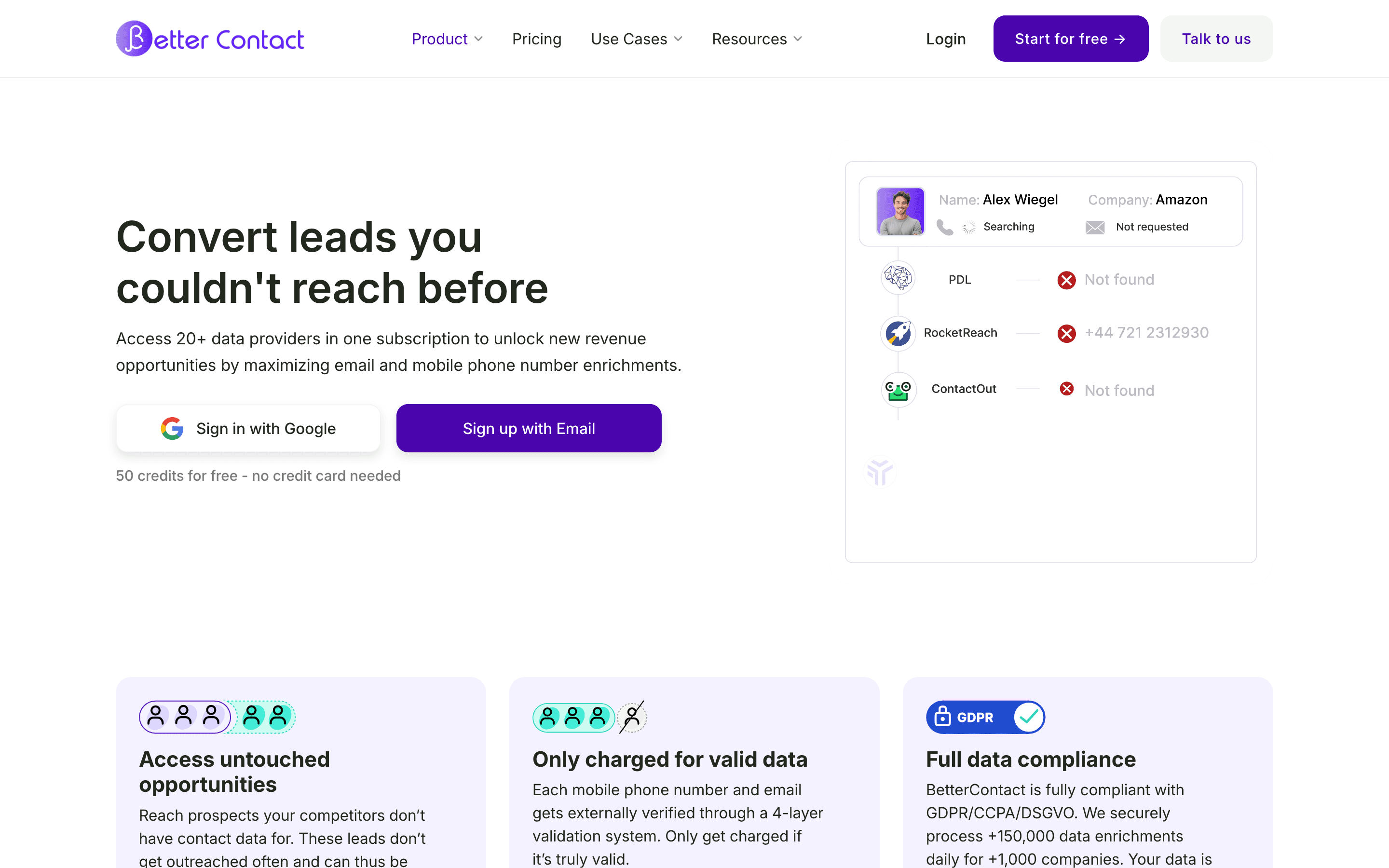
BetterContact solves a specific Lusha complaint: bulk list enrichment. Instead of a prospecting database you browse, it takes a list you already have and waterfalls it across 20+ data providers until it finds a verified email or phone, only charging credits on a confirmed hit. Starter costs $15 a month for 200 credits, undercutting Lusha's $49.90 entry price, and Pro adds catch-all verification and a Clay integration at no extra charge. The tradeoffs: there's no searchable database or lead discovery here, so you still need a separate source for finding new contacts, and it excludes Gmail and Yahoo addresses, which matters for lists heavy on small businesses. Enrichment jobs also can't be cancelled once started. For teams whose real pain with Lusha is capped bulk sessions rather than a missing prospecting tool, BetterContact is a cheap, focused fix.
Pros
- + Only charges credits for verified hits, not for misses or unverified catch-all addresses
- + Waterfall across 20+ providers in one pass instead of manually retrying several tools
- + Credits roll over month to month up to your plan's monthly cap
Cons
- – Phone number reveals cost 10x an email reveal, so mixed email-and-phone lists drain credits quickly
- – Enrichment jobs can't be cancelled once started, which is a problem if you upload the wrong file
Clay
Clay is built for teams that want to go further than a contact database, both enriching records you already have and building new prospect lists from scratch, waterfalling more than 200 data providers and layering in Claygent AI agents that can answer research questions no structured field covers, like reading a company's careers page. Pricing is usage-based rather than per-seat, so cost tracks how much you actually enrich, and Launch starts at $185 a month for 15,000 actions and 2,500 data credits, well above Lusha's entry price. Every plan, including Free, has unlimited seats, so cost has nothing to do with headcount. The tradeoff is a real learning curve: Clay's spreadsheet-style table builder takes longer to pick up than clicking reveal in a browser extension. Clay fits teams that have outgrown simple lookups and want to build custom, multi-provider enrichment logic, not teams that just want Lusha's job done a bit better.
Pros
- + Waterfall enrichment across 200+ data providers gets higher match rates than any single data source
- + Claygent AI agents can answer open-ended research questions a normal enrichment field can't, like reading a company's careers page
- + Free plan lets you test real enrichment workflows before paying
Cons
- – Usage-based pricing on actions and data credits makes monthly cost hard to predict for high-volume teams
- – Table-based workflow builder has a real learning curve compared with simpler point-and-click tools
Should your product be on this lead enrichment list?
If you build a tool that belongs next to the ones above, submit it. A human reviews every submission. Approved products get their own page with pricing and screenshots, plus a place in the comparisons where they fit. It is free. You sign in with your work email so you can follow the decision, and there is no password to create.
Lusha alternatives: FAQ
What's the best free alternative to Lusha?+
Prospeo's free plan is the closest match: 100 credits a month with no time limit, plus the Chrome extension and AI Search, more monthly capacity than the roughly 75-credit-per-month equivalent you get from Apollo's 900-credit annual free allotment.
Which Lusha alternative is cheapest to start?+
BetterContact's Starter plan is $15 a month for 200 credits, less than a third of Lusha's $49.90 Starter price, though it only enriches lists you already have rather than helping you find new leads.
Lusha alternatives: pricing compared
Entry price, billing model, and whether pricing is public. 5 of 6 publish pricing you can check without talking to sales.
| Tool | Starting price | Billing | Free option | Pricing disclosed |
|---|---|---|---|---|
| Lusha | $49.9/seat/mo | tiered | Yes | Partly public |
| Apollo | $49/seat/mo | per-seat | Yes | Public |
| Prospeo | $49/seat/mo | tiered | Yes | Public |
| ZoomInfo | Free tier + custom | quote-only | Yes | Not disclosed |
| BetterContact | $15/mo | usage-based | Trial (50 free credits on signup) | Public |
| Clay | $185/mo | usage-based | Yes | Partly public |
How we made these picks. We compare tools on public pricing, features, and hands-on assessment, then verify every price against the vendor's own page. We never accept payment for rankings. Read the full methodology. Spotted an error? Report it.