Top Persana AI Alternatives in 2026
Here for Persana AI itself? See the full Persana AI profile, pricing & reviews →
Suggest a change- If you want the closest match to Persana's AI research agents and waterfall enrichment on an actively developed platform, choose Clay. Claygent AI agents and a 200+ provider waterfall replace what Persana offered, without the uncertainty of migrating to Rox.
- If you want prospecting, enrichment, and outreach sequencing in one subscription instead of stitching tools together, choose Apollo. it bundles a 230M+ contact database, unlimited sequences, and a built-in dialer under one seat price.
- If you want the same 1-credit-email/10-credit-phone math as Persana plus native CRM sync on a self-serve plan, choose Prospeo. Growth and Pro add native HubSpot and Salesforce sync, and unused credits roll over every cycle instead of expiring.
- If you prospect straight from LinkedIn and company pages instead of a dashboard, choose Lusha. its browser extension reveals contacts directly on the page you're viewing, on LinkedIn and company sites, though bulk sessions cap out around 25 contacts and it has no built-in AI research agents the way Persana did.
- If you already have a lead list and just need emails and phone numbers filled in as cheaply as possible, choose BetterContact. Starter costs $15 a month for 200 credits, undercutting every other tool's entry price, though it has no prospecting database of its own.
- If you've outgrown self-serve credit tools and need enterprise-scale intent data and conversation intelligence under one vendor, choose ZoomInfo. it bundles buyer intent, Chorus call intelligence, and workflow automation into one negotiated contract most self-serve tools don't offer.
- If you're mid-contract on Persana today and want to keep comparing data quality before committing elsewhere, choose keep it running only while you migrate. the free 50-credit plan and your existing paid credits still work today, so you can keep using Persana while you compare alternatives. But the standalone product is being wound down into Rox, so treat this as a short migration window, not a reason to renew, and land on a supported tool like Clay or Apollo before the migration finishes.
Persana AI built its pitch around one credit pool covering email, phone, and company enrichment, plus AI agents that could research accounts and draft outreach. On March 30, 2026, Persana announced it's joining Rox and sunsetting the standalone platform, so anyone evaluating it today is really evaluating where to land once that migration finishes.
The alternatives below cover the same core job: pulling verified emails, phone numbers, and firmographic data into a lead list, at different price points and levels of AI-agent sophistication. Clay mirrors Persana's own AI-agent angle. Lusha, Prospeo, and BetterContact are simpler credit-based enrichment tools without that agent layer. Apollo bundles enrichment with outreach sequencing, and ZoomInfo sits at the enterprise end most Persana buyers would outgrow into rather than start with.
Persana AI alternatives compared
| Tool | Best for | Starting price | Free option | Last update |
|---|---|---|---|---|
| Clay | RevOps and growth teams that need to combine data from many providers into one enriched record | $185/mo | Yes | June 2026 |
| ApolloBest free alternative | Teams that want prospecting data, enrichment, and outreach sequencing in one subscription instead of stitching together a data provider and a separate sender | $49/seat/mo | Yes | June 2026 |
| ProspeoBest for native CRM sync | Sales and RevOps teams enriching CRM exports or CSV lead lists with verified emails and firmographics | $49/seat/mo | Yes | — |
| LushaBest for LinkedIn prospecting | Sales reps and RevOps teams enriching lead lists inside a browser or CRM without a heavy setup | $49.9/seat/mo | Yes | July 2026 |
| BetterContactBest value | Sales and RevOps teams that already have a list of leads or accounts and need emails and phones filled in, not a new prospecting database | $15/mo | Trial (50 free credits on signup) | — |
| ZoomInfoBest for enterprise | Mid-market and enterprise sales orgs that need a large, frequently refreshed contact database with org charts and direct dials | Free tier + custom | Yes | June 2026 |
Why teams switch from Persana AI
Persana AI is being sunset as a standalone product
Persana announced on March 30, 2026 that it's joining Rox, with existing customers migrated to Rox's GTM platform rather than the platform continuing independently.
Support quality is inconsistent on the AI SDR add-on
Persana holds a strong 4.6/5 average on G2 across 40 reviews, but at least one reviewer reports weak support and says the AI SDR add-on is priced in line with dedicated competitor 11x while only shipping on higher-priced tiers.
Only the cheapest paid tier is billed monthly
Growth, Pro, and Unlimited all show a monthly-equivalent rate but require annual billing to get it, which locks in a year of spend before you know how the migration to Rox will change the product.
Phone-heavy lookups drain the credit pool fast
A phone number lookup costs 10 credits versus 1 for an email, so the 2,000 monthly credits on Starter get used up quickly once phone numbers are part of the mix.
The best Persana AI alternatives, ranked
Clay
Clay is the closest match to what Persana AI actually did: waterfall enrichment across a large provider network (200+ vendors versus Persana's 100+) plus AI research agents, called Claygents, that fill in facts no structured database can answer. That agent layer makes it the most direct feature-for-feature swap for teams that leaned on Persana's AI research agents specifically. Pricing works the same way too, usage-based rather than a flat seat fee, with unlimited seats and tables on every plan including Free. The tradeoff is Clay's table-based workflow builder has a real learning curve, and actions, unlike data credits, don't roll over, so unused capacity each month is lost. For teams that want more than a data source, on an actively developed platform, Clay is the safer long-term home now that Persana itself is being wound down.
Pros
- + Waterfall enrichment across 200+ data providers gets higher match rates than any single data source
- + Claygent AI agents can answer open-ended research questions a normal enrichment field can't, like reading a company's careers page
- + Free plan lets you test real enrichment workflows before paying
Cons
- – Usage-based pricing on actions and data credits makes monthly cost hard to predict for high-volume teams
- – Table-based workflow builder has a real learning curve compared with simpler point-and-click tools
Apollo replaces Persana's enrichment layer and adds a full sales engagement stack on top: a 230M+ contact database, unlimited sequences, and a built-in dialer, all under one subscription. Its Free plan gives full database access with 900 credits a year, a stronger free tier than Persana's own 50-credit giveaway. Paid plans start at $49/seat/month billed annually and run on a similar credit system, 1 credit per email and 8 per phone versus Persana's 1 and 10, so the cost logic will feel familiar. The catch is Apollo charges per seat, not one shared pool, so cost scales with headcount in a way Persana's unlimited-seat plans didn't. Teams that only wanted enrichment, not sequencing or a dialer, will be paying for tools they don't use.
Pros
- + Free plan gives full access to the contact database, not just a limited sample
- + Combines data, enrichment, sequences, and a dialer in one product instead of three separate subscriptions
- + Credits are granted upfront for the year on annual plans rather than trickled out monthly
Cons
- – Credit system means the advertised seat price understates real cost for active users who unlock a lot of emails and phone numbers
- – Organization plan has a 3-seat minimum, pushing its real entry cost to at least $357/month even at the lowest advertised per-seat rate
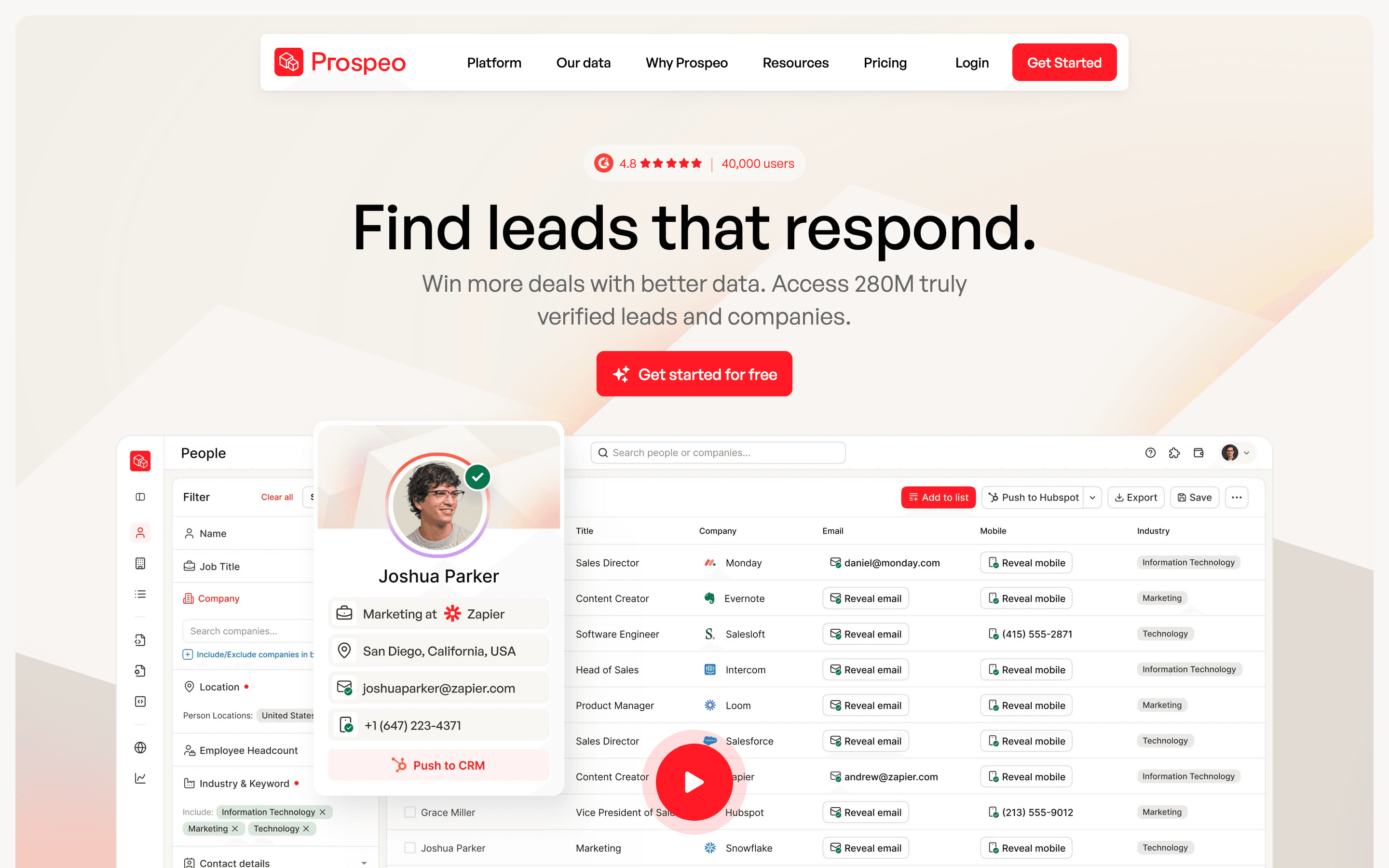
Prospeo runs the same credit logic as Persana, 1 credit per email and 10 per phone number, on published self-serve tiers from Free through Pro with no sales call required. It covers the same core job, search, enrichment, and verified contact reveals, and adds native HubSpot and Salesforce sync on Growth and Pro, something Persana didn't offer directly. The Free plan has no time limit, includes the Chrome extension and AI Search, and unused credits roll over every cycle rather than expiring, which beats Persana's tighter free tier. It won't match Persana's built-in AI research agents for open-ended account research, and mobile-heavy prospecting still burns credits fast at the 10x phone rate. For a team that wants Persana's credit math plus native CRM sync on a self-serve plan, Prospeo is the closer fit.
Pros
- + Published, self-serve pricing for every plan from Free through Pro, no contact-sales gate to see numbers
- + Unused credits roll over every cycle instead of expiring, on both monthly and yearly billing
- + Free plan has no time limit and includes the Chrome extension and AI Search, not just a stripped demo
Cons
- – Mobile number reveals cost 10 credits versus 1 for an email, so phone-heavy workflows burn through a plan fast
- – Row selection is capped at 20,000 even on paid plans below custom add-ons, which limits single-batch bulk exports
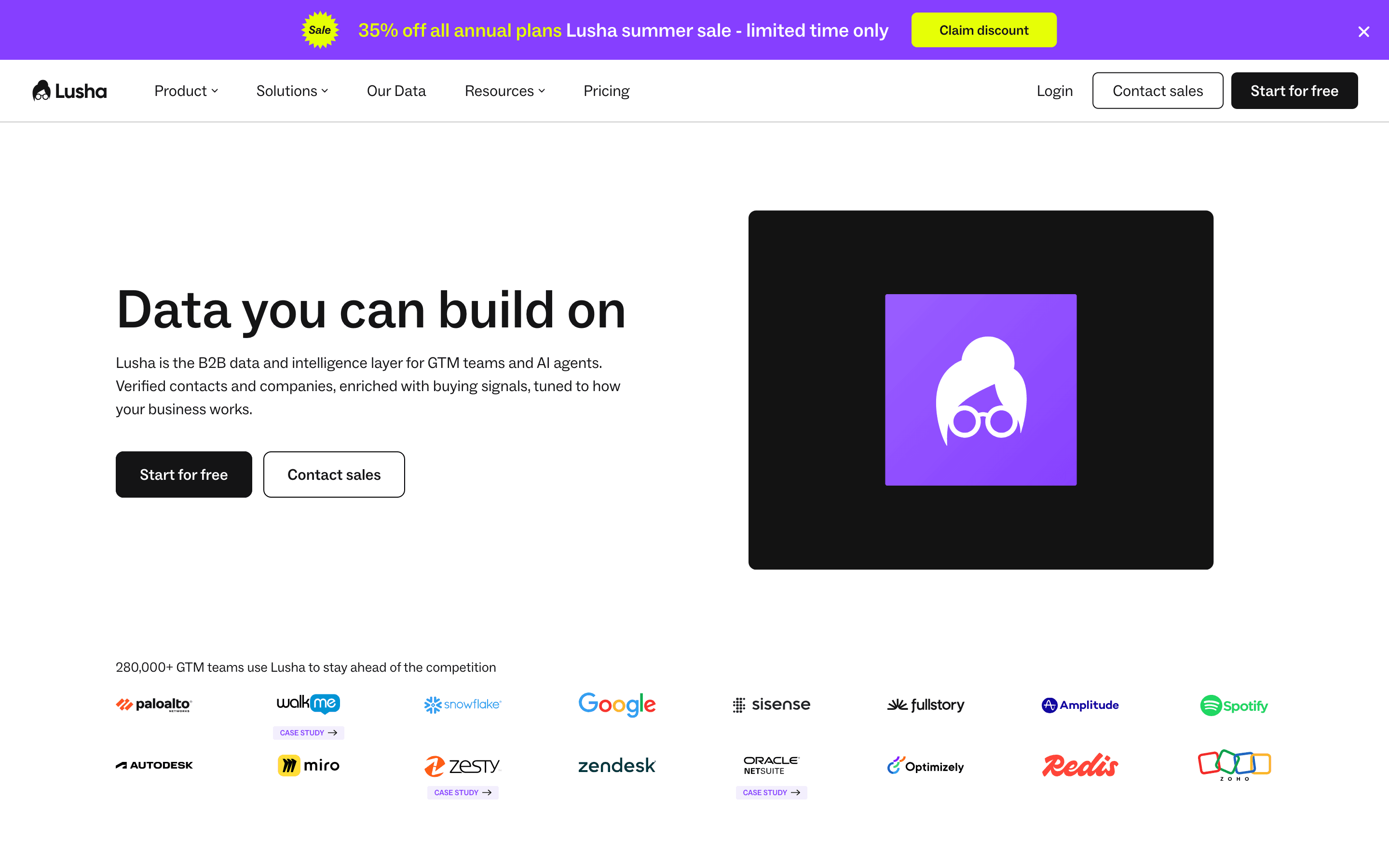
Lusha runs the closest 1-to-1 credit math to Persana: 1 credit for an email, 10 for a phone number, the same split Persana used. It ships as a browser extension you can run directly on LinkedIn and company pages, which suits reps who prospect inside LinkedIn rather than through a dashboard. Starter pricing is public at $49.90 a month per seat, with monthly plans rolling over unused credits up to 2x the plan limit. Where it falls short of Persana: no built-in AI research agents, and bulk enrichment is capped at roughly 25 contacts per session, which slows down anyone processing large list uploads the way Persana's platform could. Lusha connects natively to Salesforce, HubSpot, and other CRMs, and added a native Capsule integration this month, so enriched records sync straight into the CRM your reps already use. There's also no time-limited trial on paid plans, only the 40-credit Free plan to test with before buying. Best for reps who prospect from LinkedIn and company pages first and don't need Persana's AI research agents.
Pros
- + Public, self-serve pricing you can check without a sales call
- + Cheap per-credit cost for email reveals compared to phone reveals
- + Monthly plans roll over unused credits up to 2x the plan limit
Cons
- – Phone number reveals cost 10x an email reveal, so phone-heavy workflows drain credits fast
- – Bulk enrichment is capped at roughly 25 contacts per session, which slows down large list-building
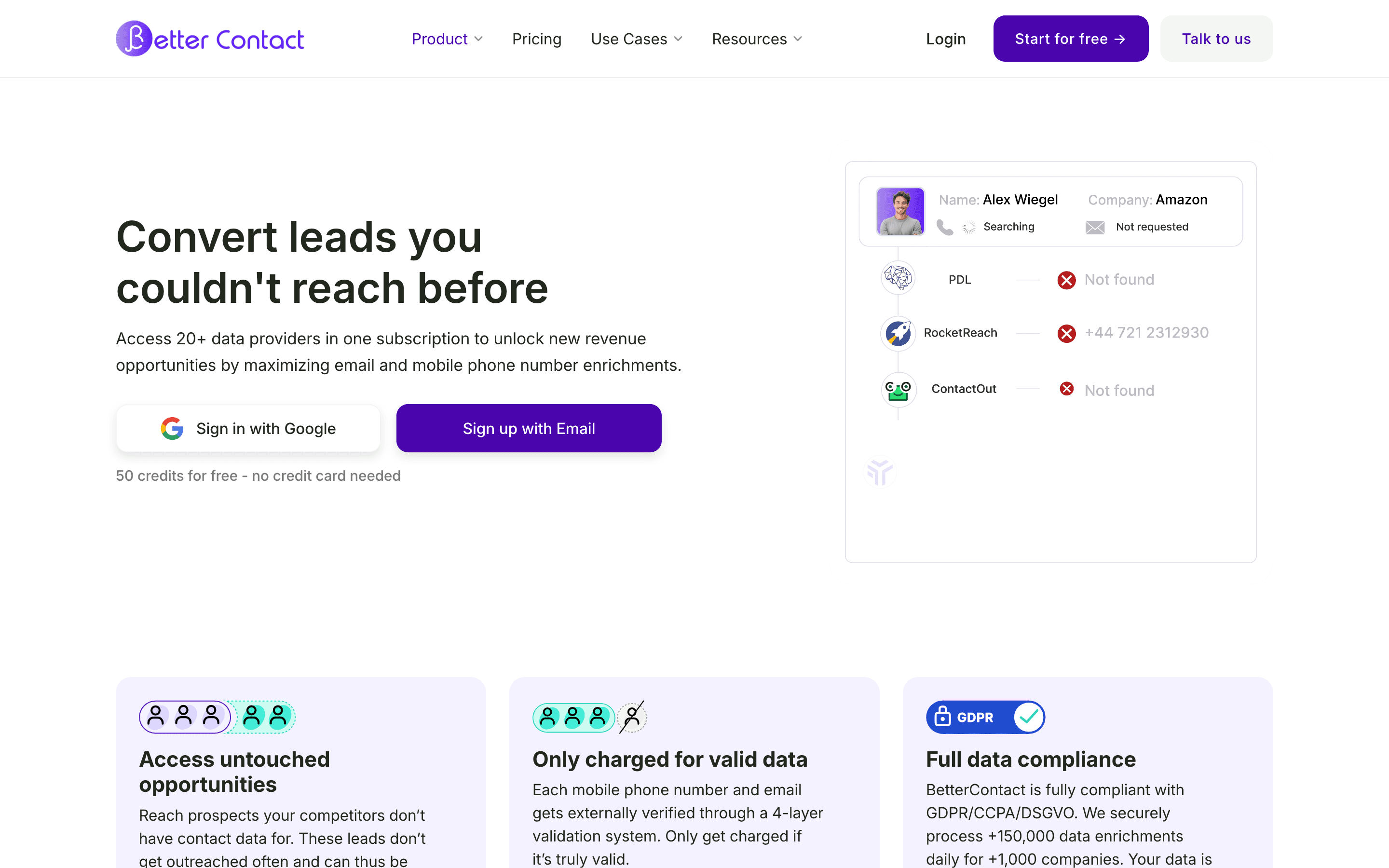
BetterContact does one job well: waterfall enrichment across 20+ data providers, charging a credit only when a lookup returns a verified email or phone number. That mirrors the waterfall mechanic Persana used internally, at a lower entry price, $15/month for 200 credits versus Persana's $85 Starter. The difference is scope: BetterContact has no prospecting database or lead search, so you bring your own list of names to enrich rather than discovering new ones the way Persana's 100+ data sources let you. It also excludes Gmail and Yahoo addresses, a real gap for lists heavy on small businesses. For teams that already have their lead lists and just need the emails and phones filled in cheaply, it beats Persana on price. For anyone who used Persana to find leads in the first place, it's a partial replacement at best.
Pros
- + Only charges credits for verified hits, not for misses or unverified catch-all addresses
- + Waterfall across 20+ providers in one pass instead of manually retrying several tools
- + Credits roll over month to month up to your plan's monthly cap
Cons
- – Phone number reveals cost 10x an email reveal, so mixed email-and-phone lists drain credits quickly
- – Enrichment jobs can't be cancelled once started, which is a problem if you upload the wrong file
ZoomInfo is the option for teams that have outgrown Persana's self-serve, transparent-pricing world entirely. It bundles a large, frequently refreshed contact database with buyer intent signals, Chorus conversation intelligence, and workflow automation, sold as one negotiated enterprise contract rather than published tiers. Vendr data puts the median contract at about $33,500 a year, far above what a Persana team pays. That buys real scale and intent data Persana never had, but every paid plan requires a sales call, and real contracts have ranged from about $7,200 to $156,000 depending on seats, credits, and add-ons. For a Persana buyer used to seeing every price and credit count on the pricing page, that opacity is a genuine step backward, even if the data volume is a step up. Only worth it once budget and headcount justify an enterprise data contract.
Pros
- + One of the largest and most frequently updated B2B contact and company databases on the market
- + Buyer intent data and Copilot signals help reps prioritize accounts instead of cold-calling a flat list
- + Bundles data, conversation intelligence (Chorus), and workflow automation under one vendor
Cons
- – No public pricing above the free tier; every paid plan requires a sales call and custom quote
- – Real-world annual contracts commonly land far above the entry list prices vendors quote in marketing, once seats, credits, and add-ons are included
Should your product be on this lead enrichment list?
If you build a tool that belongs next to the ones above, submit it. A human reviews every submission. Approved products get their own page with pricing and screenshots, plus a place in the comparisons where they fit. It is free. You sign in with your work email so you can follow the decision, and there is no password to create.
Persana AI alternatives: FAQ
What happened to Persana AI?+
Persana announced on March 30, 2026 that it's joining Rox and sunsetting the standalone platform, migrating existing customers to Rox's GTM platform over the following weeks.
What's the best free alternative to Persana AI?+
Apollo's free plan gives full access to its 230M+ contact database with 900 credits a year, a more generous free tier than Persana's own 50-credit plan.
What's the cheapest paid alternative to Persana AI?+
BetterContact's Starter plan costs $15 a month for 200 credits, the lowest entry price among Persana's true substitutes, though it only enriches lists you already have rather than finding new leads.
Persana AI alternatives: pricing compared
Entry price, billing model, and whether pricing is public. 6 of 7 publish pricing you can check without talking to sales.
| Tool | Starting price | Billing | Free option | Pricing disclosed |
|---|---|---|---|---|
| Persana AI | $85/mo | tiered | Yes | Partly public |
| Clay | $185/mo | usage-based | Yes | Partly public |
| Apollo | $49/seat/mo | per-seat | Yes | Public |
| Prospeo | $49/seat/mo | tiered | Yes | Public |
| Lusha | $49.9/seat/mo | tiered | Yes | Partly public |
| BetterContact | $15/mo | usage-based | Trial (50 free credits on signup) | Public |
| ZoomInfo | Free tier + custom | quote-only | Yes | Not disclosed |
How we made these picks. We compare tools on public pricing, features, and hands-on assessment, then verify every price against the vendor's own page. We never accept payment for rankings. Read the full methodology. Spotted an error? Report it.