Top Baseten Alternatives in 2026
Here for Baseten itself? See the full Baseten profile, pricing & reviews →
Suggest a change- If you want the fastest path from a Python function to an autoscaling GPU endpoint without learning a new deployment abstraction, choose Modal. Modal lets you decorate an ordinary Python function and get per-second billed autoscaling compute with fast cold starts and no idle charges, without adopting Baseten's separate CLI and deployment model.
- If you're serving open-weight models like DeepSeek, Kimi, or Qwen at high volume and want the cheapest published per-token rates, choose Fireworks AI. Fireworks publishes per-token rates by model size down to $0.10 per million tokens for small models and discounts cached and batched tokens by half, undercutting Baseten's Model API pricing for the same open models.
- If you want to call thousands of ready-made open source models instantly or package your own model with Cog, choose Replicate. Replicate's catalog spans thousands of public models callable with one API request, and Cog gives you a proven path from a model repo to a hosted endpoint that Baseten does not offer as a public catalog.
- If you're committing to open-weight model workloads long enough that reserved GPU cluster pricing beats on-demand rates, choose Together AI. Together AI's reserved GPU clusters drop from $3.99/hr on-demand to as low as $3.09-3.29/hr on longer commitments, a discount-for-commitment structure Fireworks AI's on-demand-only GPU rates don't offer.
- If you mainly need raw GPU capacity by the hour and are willing to manage your own serving stack, choose RunPod. RunPod's Pods start at $0.27/hr for budget GPUs and bill per second with no seat fee or subscription, which beats a managed inference platform's markup when you don't need Baseten's autoscaler and cold-start tooling.
- If you need Enterprise self-hosting in your own cloud, custom SLAs, data residency, and advanced RBAC, choose stay on Baseten. Baseten's Enterprise tier is the only one of these platforms that offers self-hosting in your own cloud, custom SLAs, and data residency control, and none of the alternatives publish an equivalent enterprise deployment option.
Baseten is built for teams deploying custom, fine-tuned, or open-source models to production without running their own GPU cluster. It bills dedicated deployments per minute of active use, sells hosted Model APIs by the token, and reserves self-hosting, custom SLAs, and RBAC for a quote-only Enterprise tier.
The teams most likely to look elsewhere are the ones whose traffic is bursty enough to make autoscaled costs unpredictable, or who want Pro and Enterprise pricing published instead of negotiated. The alternatives below cover that range: a Python-native serverless platform, two other pay-per-token inference platforms, an open-model specialist with fine-tuning built in, and a raw GPU cloud for teams who want to manage more of the stack themselves.
Baseten alternatives compared
| Tool | Best for | Starting price | Free option | Last update |
|---|---|---|---|---|
| ModalBest for serverless Python deployment | Teams running bursty or batch GPU workloads (fine-tuning, batch inference, data pipelines) who don't want to manage idle capacity | $0.0000131/core-second | Yes | June 2026 |
| Fireworks AIBest value for open-model tokens | Teams running open-weight models (Llama, Qwen, DeepSeek, Kimi, GLM) in production who don't want to manage GPUs themselves | Usage-based | Trial ($1 in free credits for new accounts to test serverless inference) | June 2026 |
| ReplicateBest model catalog | Teams that want to call a huge catalog of open and third-party models through one API without standing up their own GPU fleet | $0.000025/second | No | April 2026 |
| Together AI | Teams already committed to open-weight models (Llama, DeepSeek, Qwen, GLM, Kimi) who want one API instead of standing up their own serving stack | Usage-based | No | July 2026 |
| RunPodBest for raw GPU rental | Teams that want raw GPU access by the hour without committing to AWS/GCP reserved capacity | Usage-based | No | July 2026 |
Why teams switch from Baseten
Costs scale directly with traffic bursts
Autoscaling spins up more GPU instances automatically as traffic spikes, which makes budgets hard to forecast for bursty workloads on Baseten's dedicated deployments.
Pro and Enterprise pricing is quote-only
Baseten only publishes numbers for the Basic tier. Anything above it requires a sales call, so teams can't compare real costs upfront the way they can on Modal, Together AI, or Fireworks AI's public pricing pages.
No ongoing free usage tier
New accounts get signup credits to experiment, but once those run out every GPU minute and every token is billed, with no forever-free plan to fall back on.
The best Baseten alternatives, ranked
Modal is the closest thing to Baseten's dedicated-GPU model, but built around plain Python functions instead of a packaged deploy step. You decorate a function, and Modal provisions CPU or GPU workers, scales them to zero, and bills per second, finer-grained than Baseten's per-minute metering on the Basic tier, with the same no-idle-charge principle. Cold starts and container reuse are tuned for bursty inference, batch jobs, and fine-tuning runs. The catch is the Team plan's $250 a month platform fee sits on top of usage, a cost Baseten's Basic tier does not charge. Modal also ships Sandboxes for isolated agent and untrusted-code execution, a use case Baseten does not cover. For teams that want Python-native deploys and are comfortable with usage-based billing, Modal is the strongest like-for-like substitute for Baseten's dedicated deployments.
Pros
- + Per-second billing across CPU, GPU, and memory with no charge for idle time
- + Fast cold starts and container reuse, which matters for bursty inference and agent workloads
- + Straightforward Python decorator API instead of managing Docker/Kubernetes directly
Cons
- – Team plan adds a $250/month platform fee on top of compute usage, which is a real jump from the free Starter tier
- – GPU per-second rates are higher than renting the same GPU directly from a bare-metal cloud
Fireworks AI matches Baseten's two-sided model, hosted per-token APIs plus on-demand GPU rental for custom deployments, and undercuts it on published open-model rates, starting at $0.10 per million tokens for small models with a further 50 percent discount on cached input and batch inference. Fine-tuning (SFT, DPO, and reinforcement tuning) runs on the same account, billed by training token or GPU-hour, so a fine-tune and its serving endpoint never require a second vendor. The tradeoff is a hard 6,000 requests-per-minute ceiling on every paid account, a fixed cap most managed inference platforms don't impose on paid accounts, until you negotiate higher limits with sales. There is also no forever-free tier, only a one-dollar starter credit. For teams already serving named open models like DeepSeek or Kimi at volume, Fireworks is a close, often cheaper substitute for Baseten's Model APIs.
Pros
- + Published per-token rates for every model tier, not hidden behind a sales call
- + Cached input tokens and batch inference are both 50% cheaper than standard rates
- + Covers the full lifecycle: serverless inference, on-demand GPU rental, and fine-tuning on one platform
Cons
- – No free tier, only $1 of starter credit, so cost tracking starts almost immediately
- – Rate limits are capped at a fixed 6,000 RPM even after adding a payment method; going higher means contacting sales
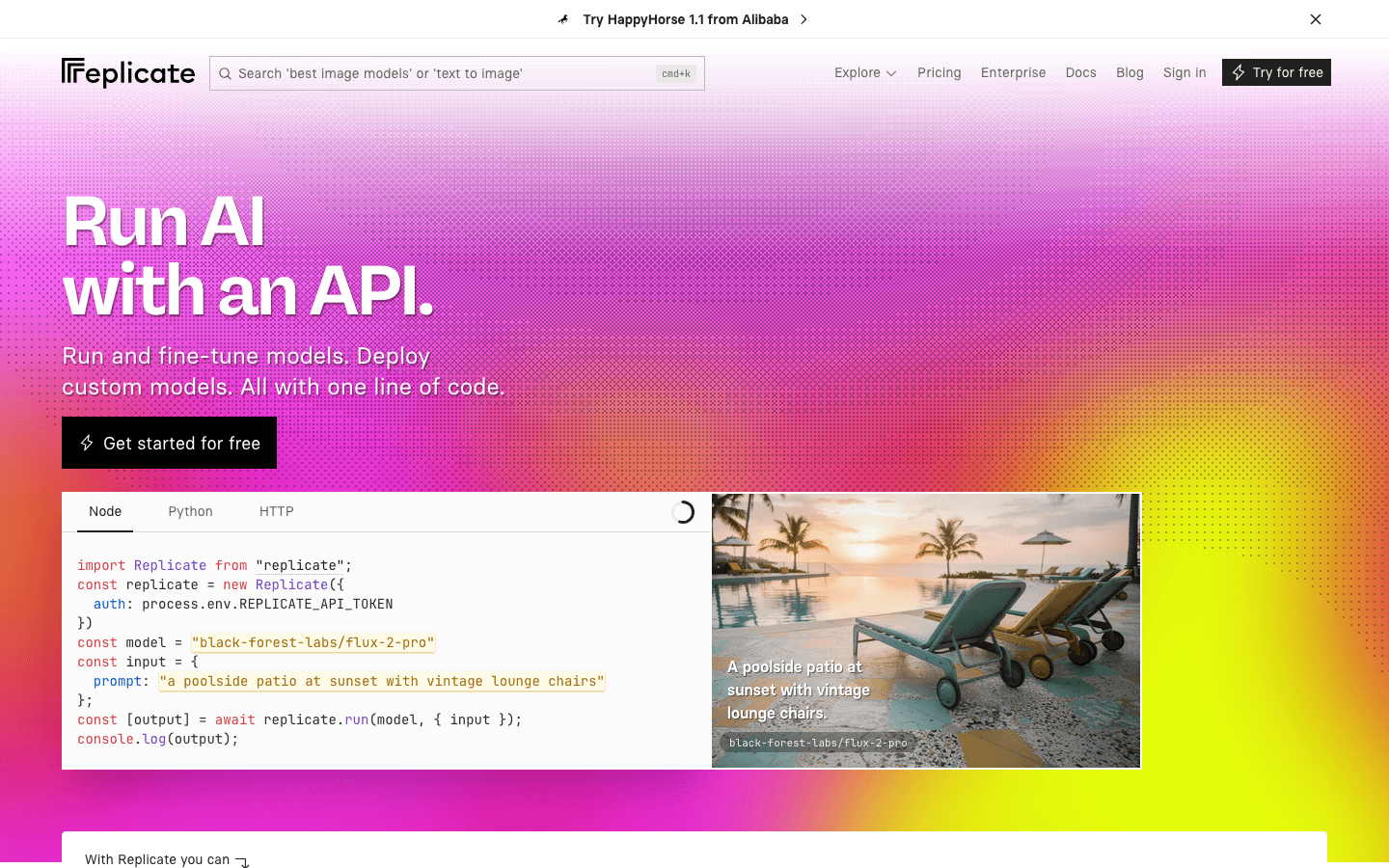
Replicate is the pick for teams that want to call a model instantly rather than deploy one. Its catalog runs to thousands of community-contributed models reachable with a single API call, and Cog gives you a well worn path from your own model repo to a hosted endpoint, similar in spirit to Baseten's dedicated deployments. Private deployments add autoscaling and scale-to-zero, but bill for the whole instance lifecycle, including idle and boot time, not just inference. Replicate also dropped monthly account spend limits in mid-2025, leaving prepaid credit as the only hard cap on spend, something to watch if predictable billing matters. Since Cloudflare's announced acquisition, Replicate still runs its own product and pricing page. For breadth of ready-to-call models, Replicate beats Baseten's more curated Model API list.
Pros
- + Pricing is transparent and published down to the per-second hardware rate, with no plan tiers or seats to negotiate
- + Huge, actively growing catalog of public models you can call with no setup
- + Cog packaging makes it straightforward to move a model from a repo into a hosted API
Cons
- – Per-second GPU rates run noticeably higher than some competitors for sustained workloads; an H100 on Replicate lists at $5.49/hr versus $3.95/hr on Modal and $3.99/hr list price ($1.89/hr at the low end) on Fal.ai for comparable hardware
- – Private deployments bill for the full instance lifecycle, so cold starts and idle warm instances add real cost beyond actual inference time
Together AI leans hardest into open-weight models: Llama, DeepSeek, Qwen, GLM, and Kimi are all servable from one account, with SFT, LoRA, and DPO fine-tuning billed by training token and a separate hourly bill once you deploy the result, much like Baseten's training-plus-deployment split. Reserved GPU cluster pricing is genuinely cheaper at scale, dropping from $3.99/hr for an on-demand H100 to as low as $3.09/hr on a long commitment. The rough edges are a hard $5 minimum credit purchase before the API answers any call, no free trial at all, and serverless rate limits that are dynamic and unpublished rather than a fixed number you can plan against. Teams standardizing on open models for both fine-tuning and serving will find Together AI a direct, often cheaper substitute for Baseten.
Pros
- + Every price is on the public pricing page, model by model, with no tiers or sales calls required
- + Covers serverless inference, dedicated GPUs, fine-tuning, and image/video/audio generation under one account and one bill
- + Reserved GPU cluster pricing drops noticeably below on-demand (H100 cluster on-demand $3.99/hr vs. reserved down to $3.29/hr for 91-180 days)
Cons
- – No free trial. The docs require a minimum $5 credit purchase before the API will respond to any call
- – Serverless rate limits are dynamic and unpublished; the docs tell you to read response headers instead of a fixed number, which makes capacity planning harder
RunPod is the rawest alternative on this list: dedicated GPU Pods, autoscaling Serverless endpoints, and multi-node Instant Clusters, all billed per second with no seat fee or platform subscription. Pod rates start at $0.27/hr for budget cards up to $7.39/hr for a B300, well below what a fully managed platform like Baseten charges for comparable dedicated compute. The tradeoff is that RunPod hands you more of the infrastructure to manage yourself. Community Cloud versus Secure Cloud pricing isn't shown side by side, stopped volumes bill at double the running storage rate, and new accounts default to an $80/hour spend cap that needs a support ticket to lift. RunPod suits teams that want the cheapest raw GPU-hour and are willing to build their own deployment tooling instead of using Baseten's managed autoscaler.
Pros
- + Per-second billing on both compute and storage, no monthly minimum or seat fee
- + One of the widest GPU catalogs of any GPU cloud, from budget RTX cards to B300
- + No charge for ingress or egress data transfer
Cons
- – Pricing page doesn't show Secure Cloud vs Community Cloud rates side by side, you find the real split only at deploy time
- – Stopped volume storage bills at $0.20/GB/month, double the running rate, which surprises people who expect stopping a pod to stop the meter
Should your product be on this ai inference & gpu infrastructure list?
If you build a tool that belongs next to the ones above, submit it. A human reviews every submission. Approved products get their own page with pricing and screenshots, plus a place in the comparisons where they fit. It is free. You sign in with your work email so you can follow the decision, and there is no password to create.
Baseten alternatives: FAQ
What is the best Baseten alternative for Python-native deployment?+
Modal is the closest match. You deploy plain Python functions as autoscaling GPU endpoints billed per second, without learning Baseten's separate CLI and deployment format.
Is there a cheaper alternative to Baseten for serving open-source models?+
Fireworks AI publishes lower per-token serverless rates for open models, starting at $0.10 per million tokens for small models, with cached input and batch inference discounted a further 50 percent.
Which Baseten alternative has the widest model catalog?+
Replicate. It runs thousands of community-contributed models callable with a single API request, plus Cog for packaging your own model into a hosted endpoint.
When should a team stay on Baseten instead of switching?+
When you need Enterprise self-hosting in your own cloud, custom SLAs, and advanced RBAC. None of Modal, Replicate, Together AI, Fireworks AI, or RunPod publish an equivalent enterprise deployment option.
Baseten alternatives: pricing compared
Entry price, billing model, and whether pricing is public. 5 of 6 publish pricing you can check without talking to sales.
| Tool | Starting price | Billing | Free option | Pricing disclosed |
|---|---|---|---|---|
| Baseten | Custom / quote | usage-based | No | Not disclosed |
| Modal | $0.0000131/core-second | usage-based | Yes | Partly public |
| Fireworks AI | Usage-based | usage-based | Trial ($1 in free credits for new accounts to test serverless inference) | Partly public |
| Replicate | $0.000025/second | usage-based | No | Public |
| Together AI | Usage-based | usage-based | No | Public |
| RunPod | Usage-based | usage-based | No | Public |
How we made these picks. We compare tools on public pricing, features, and hands-on assessment, then verify every price against the vendor's own page. We never accept payment for rankings. Read the full methodology. Spotted an error? Report it.