Top PocketBase Alternatives in 2026
Here for PocketBase itself? See the full PocketBase profile, pricing & reviews →
Suggest a change- If you want to keep self-hosting and staying open source but need more built-in services than PocketBase ships with, choose Appwrite. it matches PocketBase's open source, self-hostable model while adding auth with MFA, serverless functions across 16 language runtimes, and a hosting product, with a free Cloud plan if you'd rather not run it yourself.
- If your app has outgrown a single SQLite file and you need a real Postgres database you can scale and query with standard tools, choose Supabase. it gives you a hosted Postgres instance that any Postgres client or ORM can connect to directly, plus auth, storage, and realtime, with a free tier covering 50,000 monthly active users.
- If you're building a mobile-first app for iOS, Android, or Flutter and care more about native SDKs than self-hosting, choose Firebase. its mobile tooling is more mature than any other option here, even though you give up self-hosting entirely and pay for reads, writes, and bandwidth as you go.
- If you're starting a new TypeScript project and want real-time reactive queries without writing your own subscription logic, choose Convex. its reactive queries update your frontend automatically when the underlying data changes, which goes further than PocketBase's built-in realtime subscriptions, though it only runs as a hosted service.
- If your team already thinks in Hasura-style GraphQL permissions and wants Postgres plus a GraphQL API managed for you across several small projects on one org-level bill, choose Nhost. it bundles managed Postgres, a Hasura-compatible GraphQL API, auth, and storage under one organization, so teams already comfortable with Hasura's permission model get it run for them instead of self-hosting it.
- If your app runs fine on one server, your team is comfortable maintaining it, and you don't want a bill that moves with usage, choose stay on PocketBase. none of these alternatives match a free, single-binary, self-hosted setup with no usage-based billing and no vendor lock-in.
PocketBase packs a database, auth, file storage, and an admin UI into one free binary you run yourself. That works well for a side project or an MVP, but it runs as a single instance on embedded SQLite, and the project is maintained mostly by one person, so growing teams start looking for something with a longer scaling runway or more of a safety net.
The alternatives below all do the same core job PocketBase does: a database, auth, and storage in one place. They differ in how much you can still self-host, what database model they use, and how they bill you once you outgrow a free plan.
PocketBase alternatives compared
| Tool | Best for | Starting price | Free option | Last update |
|---|---|---|---|---|
| AppwriteBest open source upgrade from PocketBase | Developers who want auth, database, storage, and functions from one vendor instead of stitching together separate services | $25/mo | Yes | July 2026 |
| SupabaseBest for scaling to real Postgres | Developers who want real Postgres with auth and storage already wired up, not a proprietary data layer | $25/mo | Yes | July 2026 |
| FirebaseBest for mobile apps | Mobile-first apps (Android, iOS, Flutter) that want auth, a real-time database, and push notifications out of the box | Free tier + custom | Yes | July 2026 |
| NhostBest for Hasura-style GraphQL teams | Developers who want a Postgres-backed GraphQL API with auth and storage already wired together | $25/mo | Yes | June 2026 |
| ConvexBest for real-time TypeScript apps | Developers who want a database, backend functions, and real-time updates working together out of the box without assembling separate services | $25/seat/mo | Yes | April 2026 |
Why teams switch from PocketBase
PocketBase can't scale horizontally
It runs as a single instance backed by one embedded SQLite file, and the maintainer has closed community requests to support alternate distributed databases like CockroachDB or libsql/Turso instead of building in horizontal scaling.
It's maintained largely by one person
PocketBase has no company behind it, and a 2025 FLOSS/fund sponsorship for the project was withdrawn in early 2026 before any money was disbursed, over cross-border payment concerns.
Its own docs say it isn't production-ready yet
PocketBase is still pre-1.0, and the docs recommend against production-critical use unless you're willing to read the changelog and do manual migration steps between releases.
There's no official hosted version
PocketBase only ships as self-hosted software, so you're responsible for your own backups, uptime, and server maintenance. Managed hosting comes only from third parties like PocketHost, not from the PocketBase project itself.
The best PocketBase alternatives, ranked
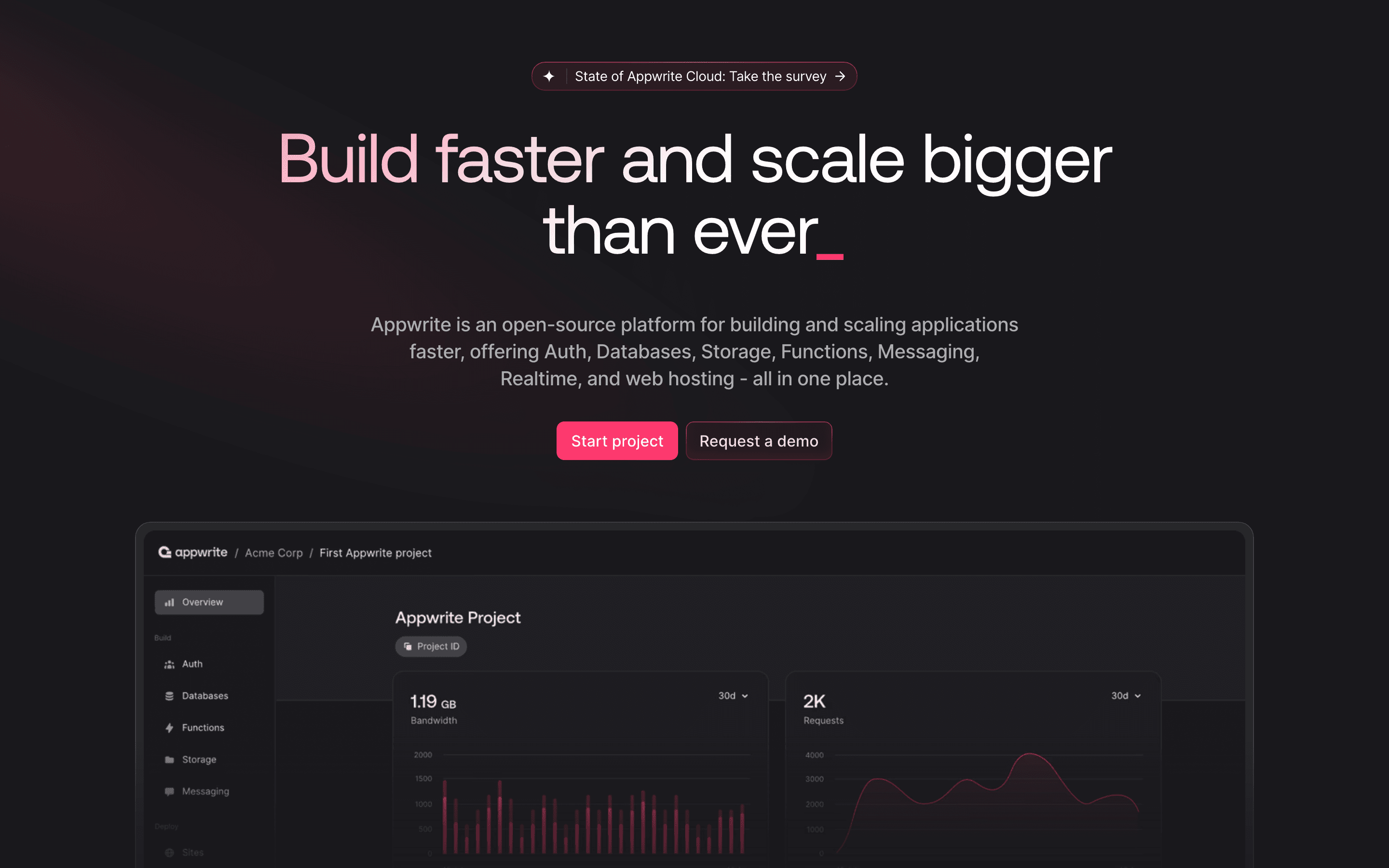
Appwrite is the closest match to PocketBase in spirit. Both are open source, and both let you self-host for free instead of paying a vendor. Where PocketBase stops at a single SQLite file and one binary, Appwrite adds a full auth system with MFA and OAuth, a document database, serverless functions across 16 language runtimes, and even a hosting product called Sites. You can keep self-hosting as your app grows, or move to Appwrite Cloud when you want someone else to run it: the free plan covers 2 projects, and Pro is $25 a month per project with dedicated resources. The tradeoff is that Pro's usage bundle has separate overage rates for bandwidth, storage, executions, and users, so a busy app can rack up several small charges instead of one flat number. If you like PocketBase's self-hosted, open source model but need more built-in services, Appwrite is the natural next step.
Pros
- + Free and open source to self-host, so you're never locked into the hosted price
- + Pricing page lists real numbers for Free and Pro, not just "contact sales"
- + One dedicated resource bundle per project on Pro instead of shared infrastructure
Cons
- – Pro's $25 base only includes a bundle of usage; every resource type (bandwidth, storage, executions, reads/writes, users, realtime) has its own separate overage rate, so a busy app can rack up several add-on charges at once
- – Free plan caps you at 2 projects and auto-pauses a project after a week of inactivity
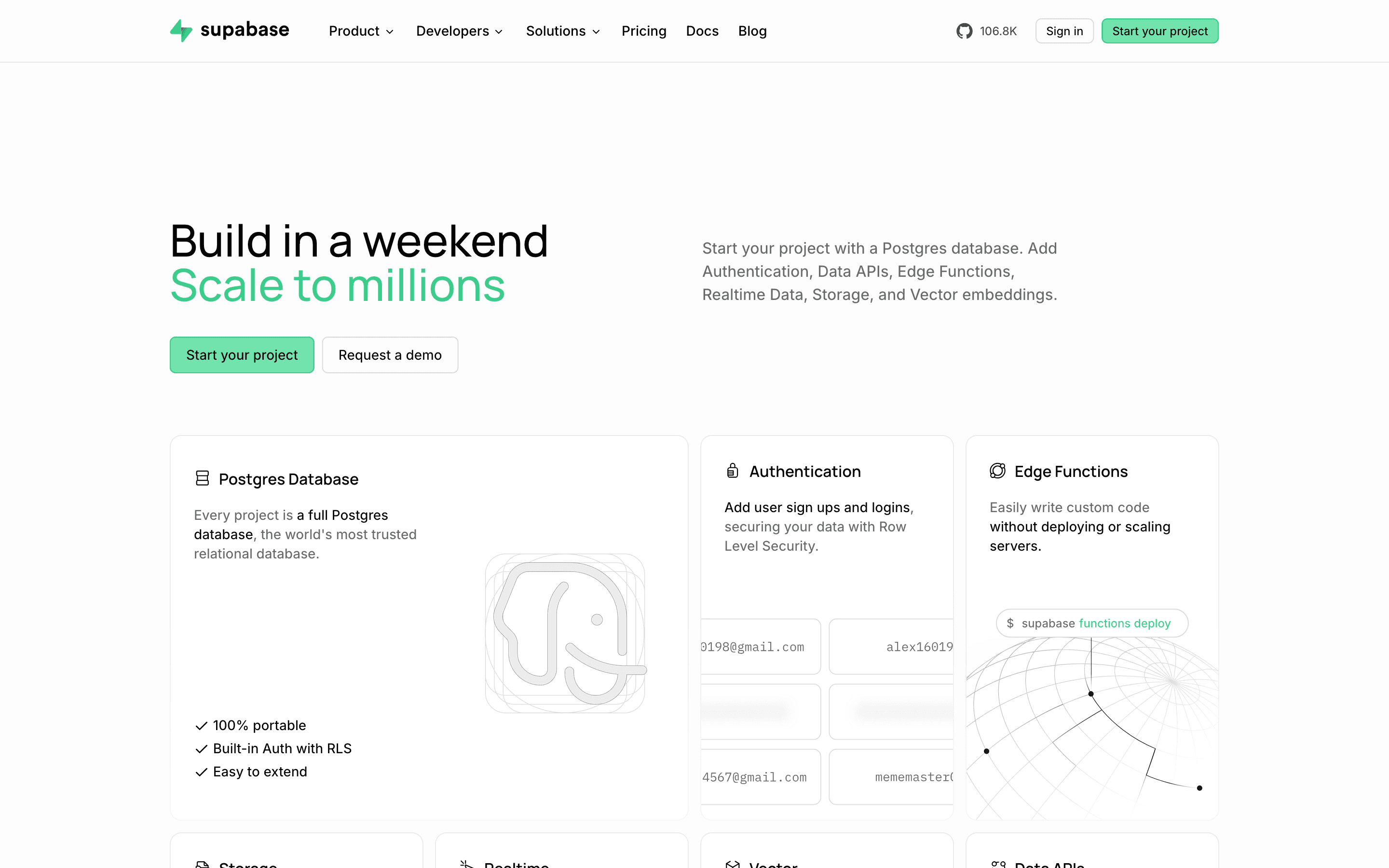
Supabase is the pick for teams that outgrow SQLite and want a real Postgres database underneath their app. Unlike PocketBase's embedded single-instance database, Supabase gives you a hosted Postgres instance you can connect to with any standard client or ORM, plus auth, storage, realtime, and edge functions layered on top. It's also open source, so the self-hosting option PocketBase users care about isn't fully gone. The free tier is generous, 50,000 monthly active users and a 500 MB database, but it caps you at 2 projects and pauses them after a week of inactivity. Pro starts at $25 a month per project, though the bill adds separate metered charges for compute, storage, egress, and users beyond the included amounts, so it takes more attention than PocketBase's flat zero. For teams that want SQL and a path to scale past one server, Supabase is the most proven option here.
Pros
- + Real Postgres underneath, so you can connect with any Postgres client or ORM and aren't locked into a proprietary query language
- + Generous free tier for a single small project, including 50,000 MAUs and 500 MB of database
- + Auth, storage, realtime, and edge functions all ship in one platform instead of four separate vendors
Cons
- – The bill has a lot of moving parts: a flat plan fee, per-project compute billed hourly, and separate overage rates for disk, egress, storage, and MAUs
- – Spend caps are on by default on Pro, so a project can get paused when you hit an included limit unless you proactively enable pay-as-you-grow

Firebase is the choice for teams that want a fully managed backend and don't care about self-hosting at all. It bundles a NoSQL database (Firestore), auth, storage, functions, hosting, and push notifications behind one Google console, with deep native SDKs for Android, iOS, Flutter, and Unity that none of the other alternatives here match. The free Spark plan is real and useful for building and testing, capped at fixed daily quotas like 50,000 Firestore reads. Past that, Blaze bills per read, write, and byte of bandwidth, so a bill can move with traffic instead of staying flat like PocketBase's zero-cost self-hosted model. There's also no way to self-host Firebase or move off Google Cloud later. If your priority is mobile-native tooling and Google's scale, that tradeoff is worth it. If you value owning your data and infrastructure the way PocketBase lets you, it isn't.
Pros
- + Free Spark tier is real and usable for building and testing, not just a demo
- + Auth, database, storage, functions, hosting, and messaging all live in one console with one SDK
- + Deep, mature tooling for Android, iOS, Flutter, and Unity that most alternatives don't match
Cons
- – No flat-rate plan. Costs scale with reads, writes, storage, and bandwidth, so a bill can jump if usage spikes or a query pattern is inefficient
- – Firestore's per-read and per-write pricing means denormalizing data or fetching related records can multiply costs compared with a single SQL join
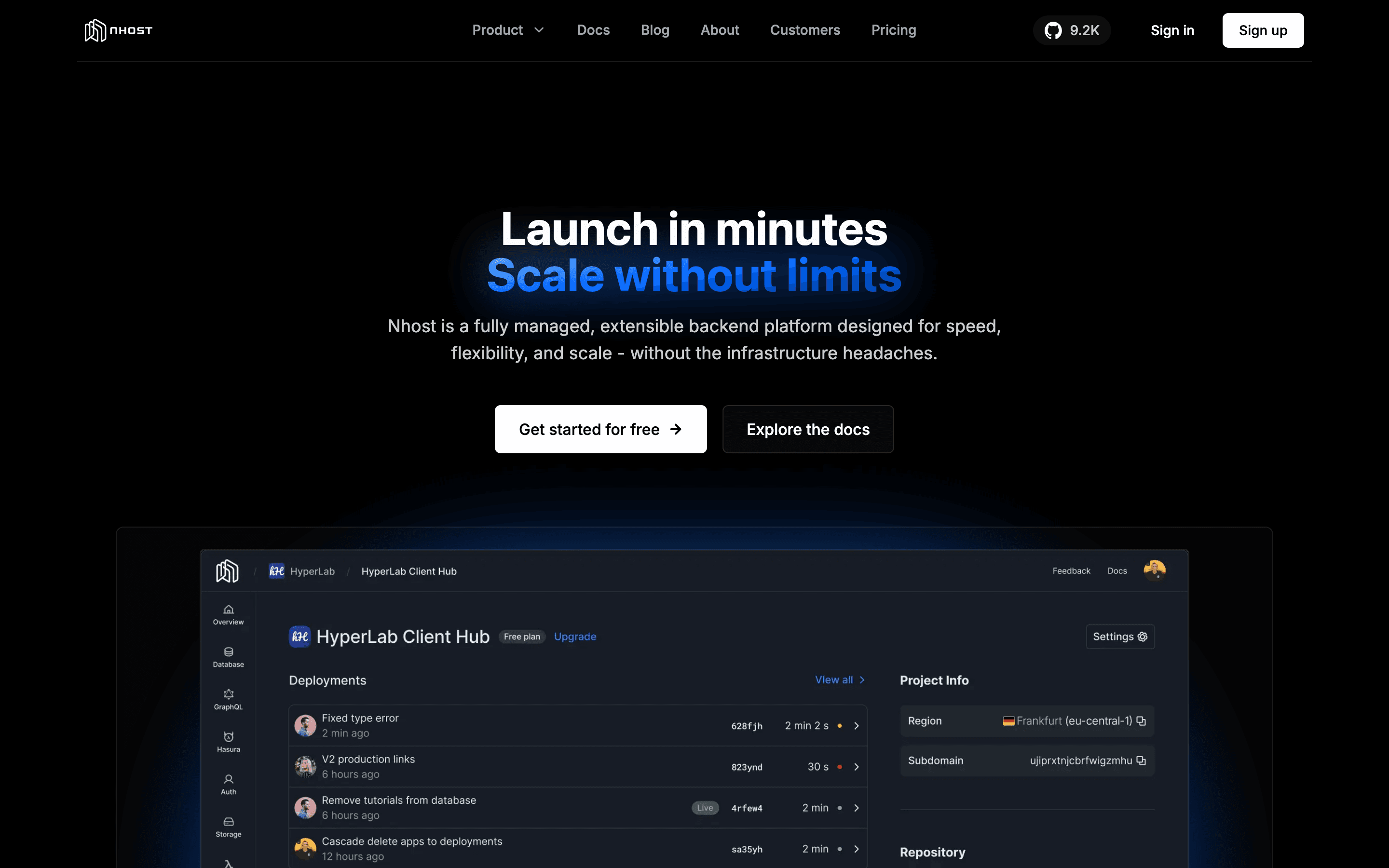
Nhost fits teams that want PocketBase's all-in-one idea but built on managed Postgres and GraphQL instead of embedded SQLite. It bundles a Postgres database, a Hasura-compatible GraphQL API (now moving to its own engine called Constellation), auth, storage, and functions, billed per organization rather than per project. The free Starter plan covers one project but pauses after a week of inactivity, so it's for testing rather than production. Pro is $25 a month with a $15 compute credit that real traffic can burn through fast, and Team jumps steeply to $599 a month for SOC 2 and support SLAs. Nhost has no clear self-hosting path the way PocketBase, Appwrite, and Supabase do, so you're trading self-hosted control for a managed GraphQL layer. It's a reasonable fit if your team already thinks in Hasura-style permissions and wants that managed for you.
Pros
- + One bill covers database, auth, storage, functions, and GraphQL instead of stitching together separate vendors
- + 7-day automated backups are included free starting on the Pro plan
- + Org-based billing lets you run multiple projects under one plan instead of paying per project
Cons
- – The free Starter plan is limited to one project and pauses after a week without activity
- – Pro's included compute credit ($15/month) is easy to exceed once you have real traffic, and overage is billed automatically with no cap
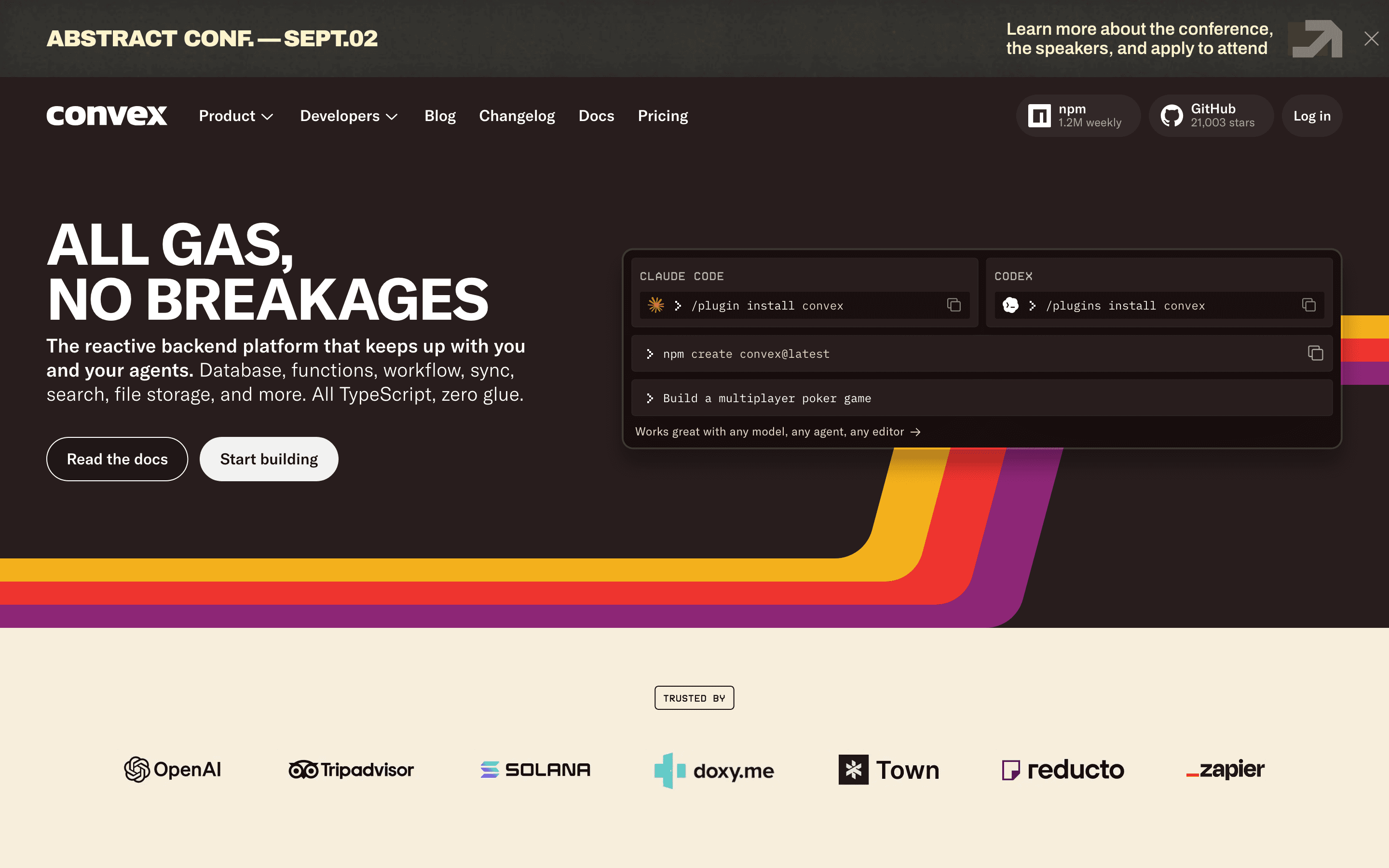
Convex is the right fit if you're building a new TypeScript app and want reactive, real-time data without writing subscription code yourself, a step beyond what PocketBase's realtime subscriptions do out of the box. You write server-side functions instead of raw SQL, and query results update on the frontend automatically when data changes. The Free plan has no time limit and covers 1M function calls and 0.5 GB of database storage, similar in spirit to PocketBase's zero-cost model, but Convex only runs as a hosted service, so there's no self-hosting fallback if you want to control your own infrastructure. Professional is $25 per developer per month, and Business jumps to a $2,500 monthly minimum. For greenfield apps built around reactivity in TypeScript, Convex beats what PocketBase offers; for teams that want to own their server, it doesn't replace that control.
Pros
- + Real-time reactive queries work automatically, no manual subscriptions or cache invalidation
- + Free tier is genuinely free with no time limit, useful for prototypes and side projects
- + Function calls, storage, and compute are all billed from one dashboard instead of stitching together separate vendor bills
Cons
- – Business plan pricing starts at a $2,500/month minimum, a large jump from the $25/seat Professional plan
- – Data egress and action compute are metered past small included quotas, so cost gets harder to predict as traffic grows
Should your product be on this backend as a service list?
If you build a tool that belongs next to the ones above, submit it. A human reviews every submission. Approved products get their own page with pricing and screenshots, plus a place in the comparisons where they fit. It is free. You sign in with your work email so you can follow the decision, and there is no password to create.
PocketBase alternatives: FAQ
What is the closest alternative to PocketBase if I want to keep self-hosting?+
Appwrite and Supabase are both open source and can be self-hosted for free, the same way PocketBase can. Appwrite is closer to PocketBase's all-in-one, single-vendor bundle; Supabase gives you a real Postgres database instead of embedded SQLite.
Is there a free alternative to PocketBase that doesn't require self-hosting?+
Supabase's free tier covers 50,000 monthly active users and a 500 MB database, and Convex's free tier has no time limit and covers 1M function calls a month. Both work for testing and small live apps but cap you below production scale.
Which PocketBase alternative scales better than a single SQLite instance?+
All five alternatives here move past PocketBase's single-instance embedded SQLite. Appwrite self-hosts its own document database rather than SQLite. Supabase and Nhost both give you managed Postgres you can scale independently of your app server. Firebase and Convex go furthest on the managed side: they're hosted services with no self-hosting option at all, so scaling is entirely on the vendor, and Nhost's own docs note it has no clear self-hosting path either.
Why do teams leave PocketBase?+
The most common reasons are that PocketBase runs as a single SQLite instance with no horizontal scaling path, it's maintained mostly by one person which is a bus-factor risk, and its own docs say it isn't recommended yet for production-critical apps.
PocketBase alternatives: pricing compared
Entry price, billing model, and whether pricing is public. 4 of 6 publish pricing you can check without talking to sales.
| Tool | Starting price | Billing | Free option | Pricing disclosed |
|---|---|---|---|---|
| PocketBase | Free tier + custom | free | Yes | Not disclosed |
| Appwrite | $25/mo | usage-based | Yes | Partly public |
| Supabase | $25/mo | tiered | Yes | Partly public |
| Firebase | Free tier + custom | usage-based | Yes | Not disclosed |
| Nhost | $25/mo | tiered | Yes | Partly public |
| Convex | $25/seat/mo | usage-based | Yes | Partly public |
How we made these picks. We compare tools on public pricing, features, and hands-on assessment, then verify every price against the vendor's own page. We never accept payment for rankings. Read the full methodology. Spotted an error? Report it.