Adyen Review
Enterprise payment platform for cards, wallets, and local methods worldwide
Is this your product? Claim this page · Request a change
Looking for a Adyen alternative? See our ranked comparison.→What is Adyen?
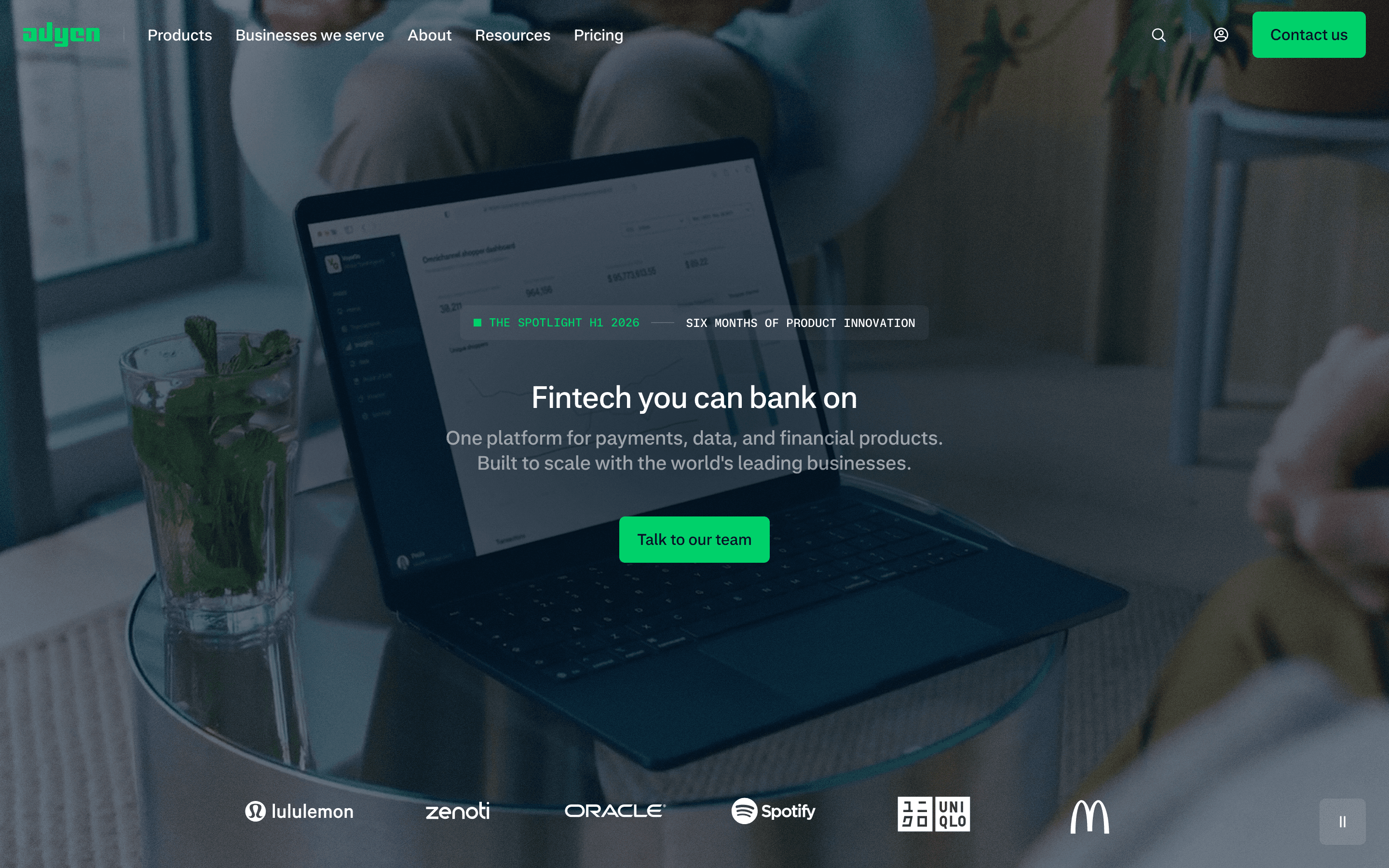
Adyen is a single platform for accepting payments (cards, wallets, bank transfers, and dozens of local payment methods) plus a growing set of financial products like business accounts, capital advances, and payouts for platforms and marketplaces. It's built as one integration that connects directly to card networks and local schemes rather than routing through a chain of third-party processors.
Adyen targets larger and fast-growing merchants rather than solo developers or small stores. Pricing reflects that: rates are interchange++ (cost-plus, not a flat blended percentage), there's a minimum invoice by industry, and getting your actual rate means a sales conversation rather than a self-serve signup.
Adyen doesn't sell a sales-tax product the way some payment platforms do. If tax calculation and filing matter to you, you'll pair Adyen with a separate tax tool rather than get it bundled in.
Adyen screenshots
Who it's for
- ✓ Larger or high-volume merchants who can negotiate rates and want one platform across regions, cards, and local payment methods
- ✓ Platforms and marketplaces that need built-in payout, payout timing, and capital products alongside processing
- ✓ International sellers who want direct acquiring across many countries instead of stacking regional processors
Who should look elsewhere
- ✗ Solo founders or small stores who want to see an exact price and sign up in an afternoon without a sales call
- ✗ Low-volume businesses that can't clear Adyen's minimum monthly invoice or don't want interchange++ pricing complexity
- ✗ Teams that want payments and sales tax handled in the same bill from one vendor
Pros
- + No setup fee, monthly platform fee, or closure fee for core processing
- + One integration covers cards, wallets, and a long list of local payment methods across regions
- + Interchange++ pricing means you see the actual interchange and scheme cost rather than a marked-up blended rate
- + Built-in payout, platform, and capital products for marketplaces that need to route money to sellers
Cons
- – No published starting price. You have to talk to sales to know your real rate and minimum invoice
- – Minimum monthly invoice requirement isn't disclosed publicly and varies by industry
- – Onboarding and KYC checks are described as slow and paperwork-heavy by smaller merchants
- – Trustpilot reviews skew heavily negative, with recurring complaints about held funds and slow account support
Adyen pricing
What you pay for
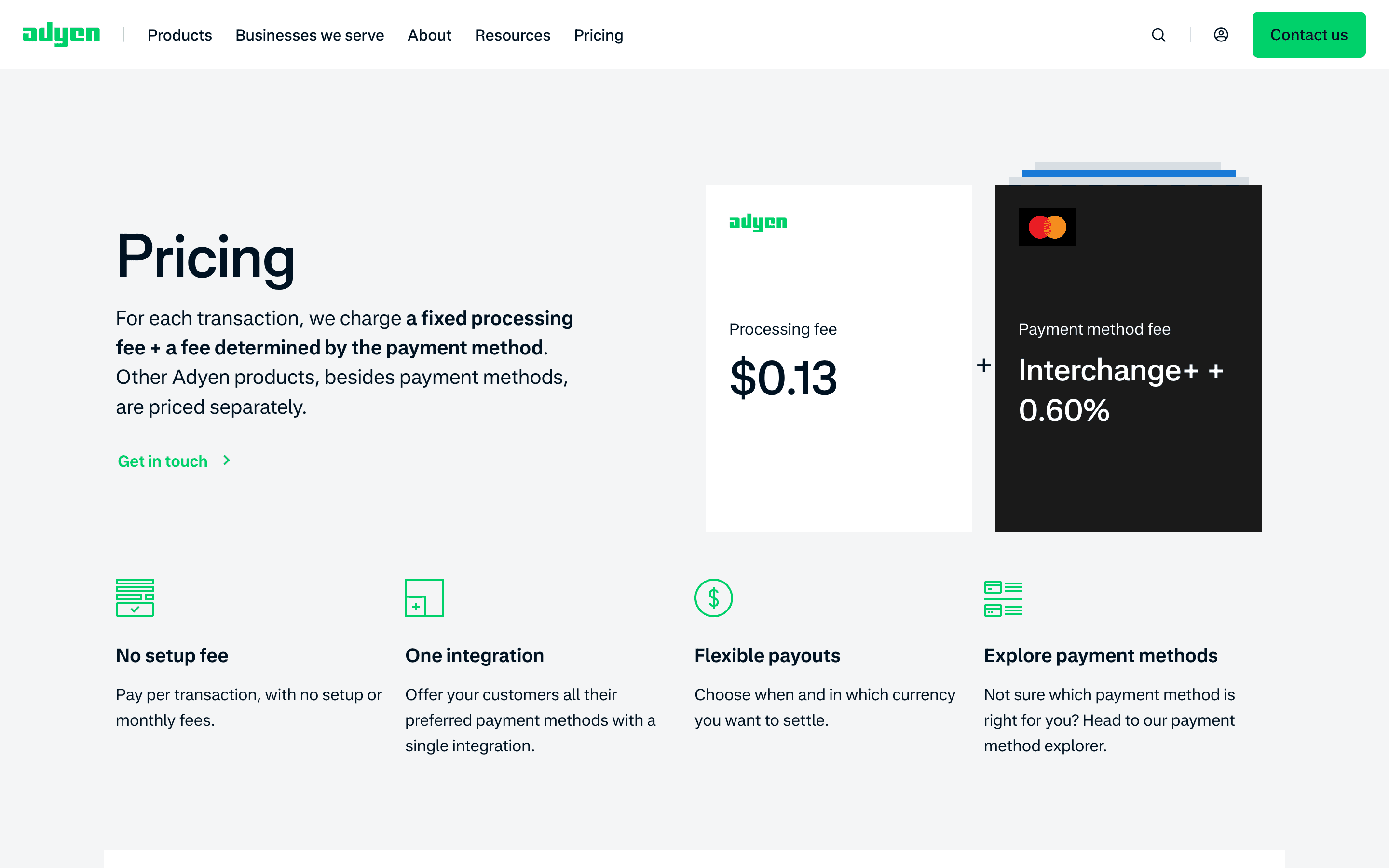
You pay a small fixed fee plus a variable fee on every transaction, and the variable part depends on the card network, payment method, and region, not one flat percentage. Adyen shows indicative per-method rates on its pricing page but tells you outright to contact sales to confirm your real numbers, and it sets an unpublished minimum monthly invoice by industry. There's no monthly platform fee or setup cost, so the entry barrier is the minimum invoice and the sales conversation, not a subscription price.
You pay for what you consume rather than a per-seat fee, so cost scales with usage.
| Plan | Price | Highlights |
|---|---|---|
| Cards (Visa, Mastercard, Maestro) | Custom | $0.13 fixed fee per transaction · plus interchange and scheme fees passed through at cost · plus a 0.60% Adyen markup |
| Alipay, WeChat Pay, UnionPay | Custom | $0.13 fixed fee plus 3% of transaction value |
| Apple Pay / Google Pay | Custom | $0.13 fixed fee plus whatever fee applies to the underlying card |
| Klarna and other BNPL | Custom | $0.13 fixed fee plus rates that range roughly 1% to 8%, depending on the specific method (Klarna, Affirm, Clearpay, Oney, and others), region, and terms |
| PayPal and some regional methods | Custom | Priced through a direct contract, not on the public rate card |
Adyen publishes indicative per-method rates on its pricing page but its own copy calls them indicative and asks you to talk to sales to confirm what you'd actually pay. There's no setup fee, monthly fee, or closure fee, but Adyen sets a minimum invoice amount that depends on your industry and business model, and that number isn't published. Card pricing is interchange++, so your real rate moves with card type, region, and volume rather than sitting at one fixed percentage. Treating this as quote-only for a startingPrice: the per-method numbers are a starting point for a sales conversation, not a price you can commit to without talking to Adyen.
Pricing verified July 22, 2026 · source
How Adyen's pricing compares
Adyen next to its closest alternatives on entry price, billing, and whether pricing is public.
Is Adyen still actively developed?
Last significant update: May 2026. Adyen's Q1 2026 update announced the agreement to acquire Talon.One (loyalty and promotions engine) and the launch of Intelligent Money Movement, a new set of capabilities for routing and optimizing how funds move for platform customers.
Top Adyen alternatives
Adyen FAQ
How much does Adyen cost?+
There's no published flat price. Card payments run a $0.13 fixed fee plus interchange and scheme fees plus a 0.60% Adyen markup, and other methods have their own indicative rates on the pricing page. Adyen tells merchants directly to contact sales to confirm actual pricing.
Is there a monthly fee or minimum with Adyen?+
No setup fee, monthly platform fee, or closure fee, but Adyen does set a minimum invoice amount that depends on your industry and business model. That minimum isn't published, so you'd confirm it with sales.
Does Adyen handle sales tax?+
No. Adyen is a payments and financial platform; it doesn't offer a tax calculation or filing product. You'd pair it with a dedicated tax tool if you need that.
Why do some merchants complain about Adyen?+
Recurring complaints on review sites center on funds being held with limited explanation, slow account support, and onboarding that smaller teams find heavy on paperwork and KYC checks.