Polar Review
Merchant-of-record billing for software and AI companies, with usage-based pricing built in
Is this your product? Claim this page · Request a change
Looking for a Polar alternative? See our ranked comparison.→What is Polar?
Polar is a merchant-of-record billing platform: it takes on the sales tax and VAT registration in every country you sell into, handles the actual checkout and card processing (through Stripe under the hood), and pays you out after taking a cut. That's the core trade you're making versus a payment processor like Stripe or Braintree: you give up some margin per sale, and in exchange you stop filing tax returns in every jurisdiction your customers are in.
It leans hard into usage-based billing on top of the standard subscription and one-time-purchase models, which is why it gets picked up a lot by AI and dev-tool companies that bill by API calls, tokens, or credits rather than flat seats. In May 2026 Polar moved from a single flat rate to four tiers, with the free tier now costing more per transaction than it used to, and lower rates gated behind $20-$400/month plans.
Polar screenshots
Who it's for
- ✓ Indie developers and small SaaS teams who want to skip registering for sales tax and VAT themselves
- ✓ AI and API-first products billing by usage, credits, or tokens rather than flat seats
- ✓ Teams that would rather pay a higher per-transaction cut than deal with tax compliance in-house
Who should look elsewhere
- ✗ Higher-volume businesses that have outgrown a percentage-of-revenue fee and want a flat processor rate instead
- ✗ Teams that need fast, guaranteed support response times, since Polar's support has been reported as slow
Pros
- + Handles merchant-of-record tax compliance, so you don't register for sales tax or VAT yourself
- + Built for usage-based and credit-based billing out of the box, not bolted on
- + Fee schedule is fully published, including the exact grandfather cutoff date, with no quote-only tiers
- + Free to start with no monthly plan fee required
Cons
- – Raised its free-tier rate from 4% + $0.40 to 5% + $0.50 in May 2026 for any organization created after the cutoff
- – Lower rates now require paying $20-$400 a month on top of the transaction fee, a real cost increase versus the old flat rate
- – Upgrading to a paid plan permanently forfeits grandfathered legacy pricing, even if you later downgrade
- – Support has been described as slow or non-responsive in user reports
- – Adds a 1.5% surcharge on international cards and a flat $15 per chargeback on top of the base rate
Polar pricing
What you pay for
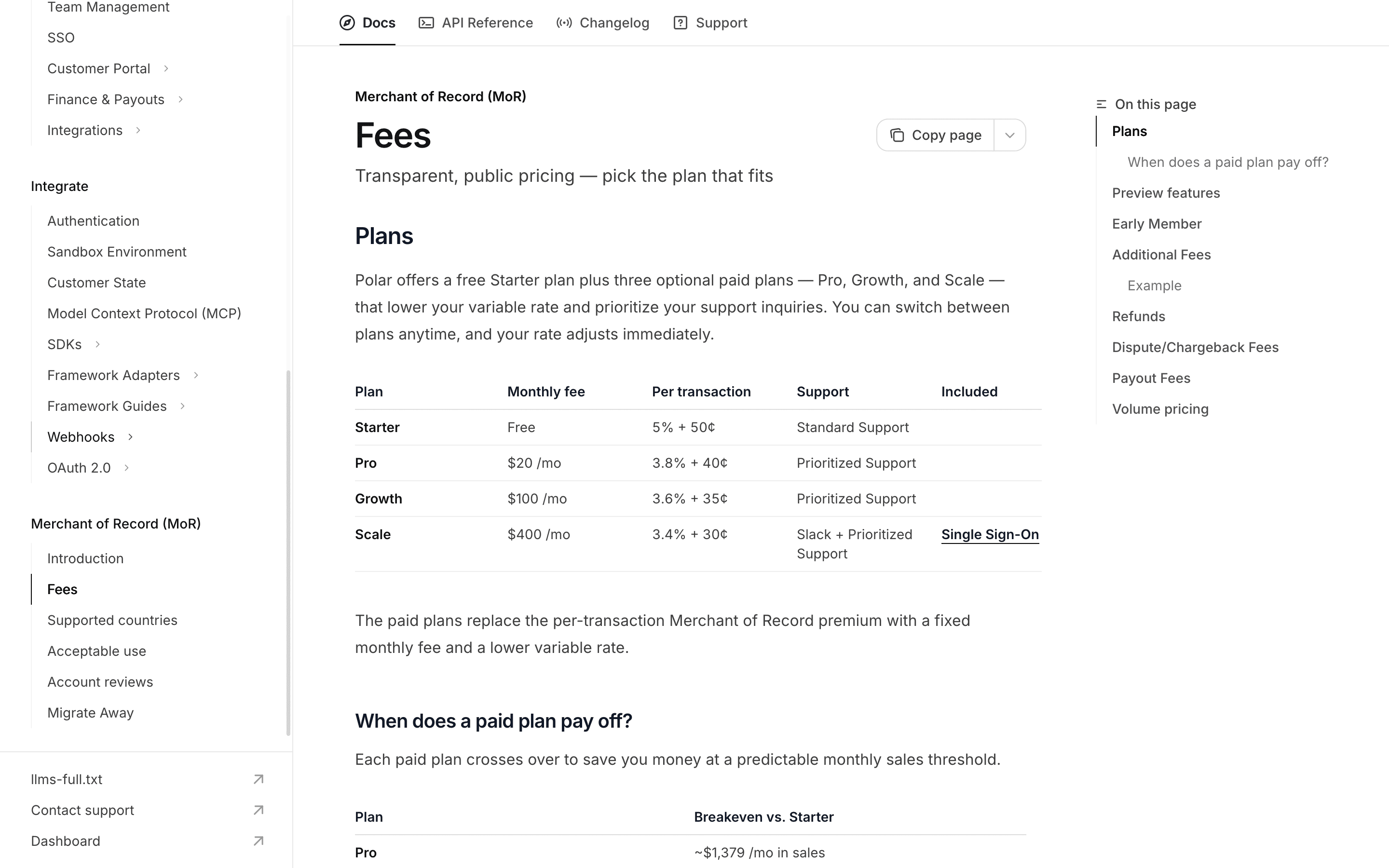
You pay Polar as a cut of each sale, not a seat fee. The rate depends on which plan you're on: free gets you the highest per-transaction rate, and each paid tier ($20, $100, or $400 a month) buys a lower percentage. Every number here, including the grandfather cutoff date, is published on Polar's own fee page. Nothing is quote-only.
It has a free plan, so you can start at no cost in Payment Processing.
| Plan | Price | Highlights |
|---|---|---|
| Starter | Free | 5% + $0.50 per transaction · Standard support · For organizations created on or after May 27, 2026 |
| Pro | $20/mo | 3.8% + $0.40 per transaction · Prioritized support · Pays off around $1,379/month in sales |
| Growth | $100/mo | 3.6% + $0.35 per transaction · Prioritized support · Pays off around $5,634/month in sales |
| Scale | $400/mo | 3.4% + $0.30 per transaction · Single sign-on (SSO) · Slack access plus prioritized support · Pays off around $19,048/month in sales |
Polar is free to start, then takes a cut of every transaction on top of an optional monthly plan fee. New organizations (created on or after May 27, 2026) start on 5% + $0.50 per transaction; paying $20-$400/month buys down that rate to as low as 3.4% + $0.30. Organizations created before May 27, 2026 keep a grandfathered 'Early Member' rate of 4% + $0.40 plus 0.5% on subscriptions, indefinitely, but lose it for good if they ever upgrade to a paid plan. All plans add 1.5% on non-US cards and a flat $15 per chargeback, and payouts run through Stripe at $2/month plus 0.25% + $0.25 per withdrawal.
Pricing verified July 22, 2026 · source
How Polar's pricing compares
Polar next to its closest alternatives on entry price, billing, and whether pricing is public.
Is Polar still actively developed?
Last significant update: May 2026. Polar introduced paid Pro, Growth, and Scale plans with lower per-transaction fees, raised the free Starter rate to 5% + $0.50 for new organizations, and grandfathered existing organizations at their old rate as long as they never upgrade.
Top Polar alternatives
Polar FAQ
How much does Polar cost?+
Polar has no monthly fee to start. The free Starter plan takes 5% + $0.50 per transaction for organizations created on or after May 27, 2026. Paying $20, $100, or $400 a month for the Pro, Growth, or Scale plan lowers that rate to as low as 3.4% + $0.30. Organizations created before May 27, 2026 keep an older 4% + $0.40 rate as long as they never upgrade.
Does Polar have a free plan?+
Yes, the Starter plan has no monthly fee. You still pay a per-transaction percentage on every sale, it's just the highest of Polar's four rates.
Does Polar handle sales tax and VAT?+
Yes. Polar acts as merchant of record, which means it registers for and remits sales tax and VAT in the countries your customers buy from, instead of you doing it yourself.
What happens if I upgrade my Polar plan?+
If your organization is on the older grandfathered rate from before May 27, 2026, upgrading to any paid plan permanently gives up that legacy pricing, even if you downgrade again later.