Top Axiom Alternatives in 2026
Here for Axiom itself? See the full Axiom profile, pricing & reviews →
Suggest a change- If you want to self-host the observability stack instead of paying any cloud vendor for it, choose Grafana. You can run the open source LGTM stack (Loki, Tempo, Mimir) yourself and pay only your own infrastructure, something Axiom never offers since even its Bring Your Own Cloud plan is still an Axiom-run service.
- If your incidents hinge on slicing traces by high-cardinality fields like user ID, region, or feature flag, choose Honeycomb. BubbleUp automatically surfaces which dimensions differ in an anomaly instead of making you guess which dashboard to build, which is a debugging job Axiom's APL queries don't automate.
- If you want one vendor covering infrastructure, APM, RUM, and security instead of stitching tools together, choose Datadog. Datadog ships 1,000+ integrations and a full monitoring suite in one product, while Axiom stays focused on logs, traces, and metrics and has no real APM or RUM of its own.
- If you need FedRAMP or HIPAA eligibility and can absorb per-seat pricing for incident access, choose New Relic. New Relic's Data Plus add-on already has FedRAMP Moderate and HIPAA eligibility, while Axiom still sells SSO, RBAC, directory sync, and audit log as separate paid line items.
- If your top problem is catching exceptions tied to the release that caused them, not ingesting general application logs, choose Sentry. Sentry ties every error to the responsible commit and its Seer AI agent can hand a fix straight to GitHub Copilot, a job Axiom's log-and-trace platform isn't built to do.
- If you're already on OpenTelemetry and just want the cheapest place to keep full-fidelity logs and traces without sampling, choose stay on Axiom. Its $25/month Axiom Cloud plan includes 1,000 GB/month of ingest with no per-seat charge up to 100 users, or you can stay on the Personal plan's 500 GB/month forever-free allowance if you don't need to pay at all, and low compressed storage cost plus Correlations linking related signals across datasets mean you don't need a pricier all-in-one suite.
Axiom keeps logs, traces, and metrics cheap at high volume by charging for ingest and query compute instead of hosts or seats. That works well until an incident sends your query bill up at the worst possible time, or until you need mature APM, RUM, or bundled security that Axiom still prices as separate add-ons.
The alternatives below split into two groups: cost-focused platforms like Grafana and Honeycomb that share Axiom's usage-based philosophy, and broader incumbents like Datadog and New Relic that trade a simpler pricing model for one vendor covering infra, APM, and logs together. Sentry fits a narrower job: catching exceptions tied to a release rather than ingesting general logs at scale.
Axiom alternatives compared
| Tool | Best for | Starting price | Free option | Last update |
|---|---|---|---|---|
| GrafanaBest open-source alternative | Teams that already run Prometheus, Loki, or Tempo and just want a dashboard layer on top | $19/mo | Yes | June 2026 |
| HoneycombBest for high-cardinality debugging | Teams debugging production issues that need to slice traces by arbitrary high-cardinality fields (user, request ID, feature flag) instead of a fixed dashboard | $150/mo | Yes | June 2026 |
| DatadogBest all-in-one platform | Teams that want one platform for infra, APM, and logs instead of stitching together open source tools | $15/host/mo | Yes | June 2026 |
| New Relic | Teams that want one platform for APM, infra, logs, and traces instead of running several separate tools | $10/seat/mo | Yes | June 2026 |
| SentryBest for error tracking tied to releases | Engineering teams that want error alerts tied directly to the code and release that broke | $26/mo | Yes | July 2026 |
Why teams switch from Axiom
Query compute costs can spike unpredictably during an incident
Axiom's query compute is metered, so running lots of ad hoc diagnostic queries and refreshing dashboards during an incident, exactly when teams query the most, can push the bill up right when it's already under pressure.
Security and compliance features are unbundled extra costs
RBAC, SSO, directory sync, and audit log are each separate monthly line items on top of the base plan ($50, $100, $100, and $50 a month respectively), rather than bundled into a higher tier the way some competitors do it.
APM and dashboarding are newer and thinner than dedicated tools
Axiom's OpenTelemetry metrics and dashboards only reached general availability in 2026, so teams that need mature distributed tracing or code-level performance monitoring often add or switch to a dedicated APM product instead.
No published price for data-residency or self-hosted-style deployments
Teams that need custom or forever retention through the Bring Your Own Cloud plan have to talk to sales to get any number, since it isn't published the way Axiom Cloud's usage rates are.
The best Axiom alternatives, ranked
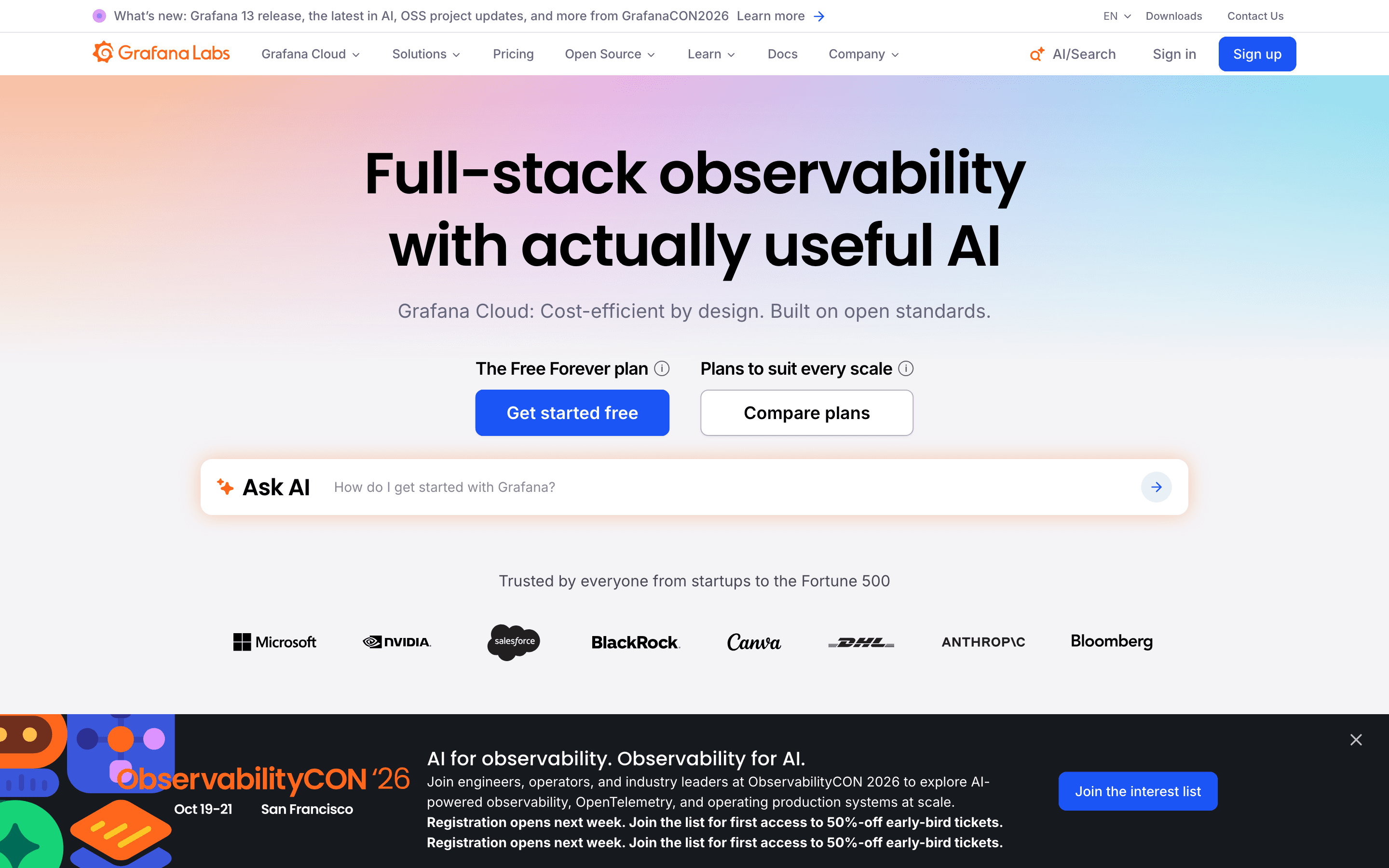
Grafana is the closest match to Axiom's own pitch: keep cost down at high volume, don't force sampling, and let engineers query freely. The real difference is that Grafana lets you skip Grafana Cloud's meter entirely and self-host the open source LGTM stack (Loki, Tempo, Mimir) for the price of your own infrastructure, something Axiom never offers since even its Bring Your Own Cloud plan is still an Axiom-run service. Grafana Cloud's free tier, 10k metric series and 50 GB each of logs, traces, and profiles a month, is comparable to Axiom's. The catch is that Grafana's metrics pricing is driven by cardinality rather than raw volume, so a single busy Kubernetes cluster can multiply your bill in ways that surprise teams coming from Axiom's simpler ingest-based model.
Pros
- + Real free forever tier: 10k metric series and 50 GB each of logs, traces, and profiles per month, no credit card
- + Self-hosting the open-source core is a genuine option, not just a marketing claim, so you're never fully locked into the cloud bill
- + Volume discounts kick in automatically as usage grows, and Adaptive Metrics/Adaptive Logs can cut ingested volume automatically
Cons
- – Metrics pricing is driven by cardinality, not raw data volume, so adding labels or a second Kubernetes cluster can multiply your series count and your bill far faster than you'd expect
- – Costs are metered across seven or more independent dimensions (metrics, logs, traces, profiles, k6, synthetics, hosts), each with its own rate, which makes the bill hard to forecast
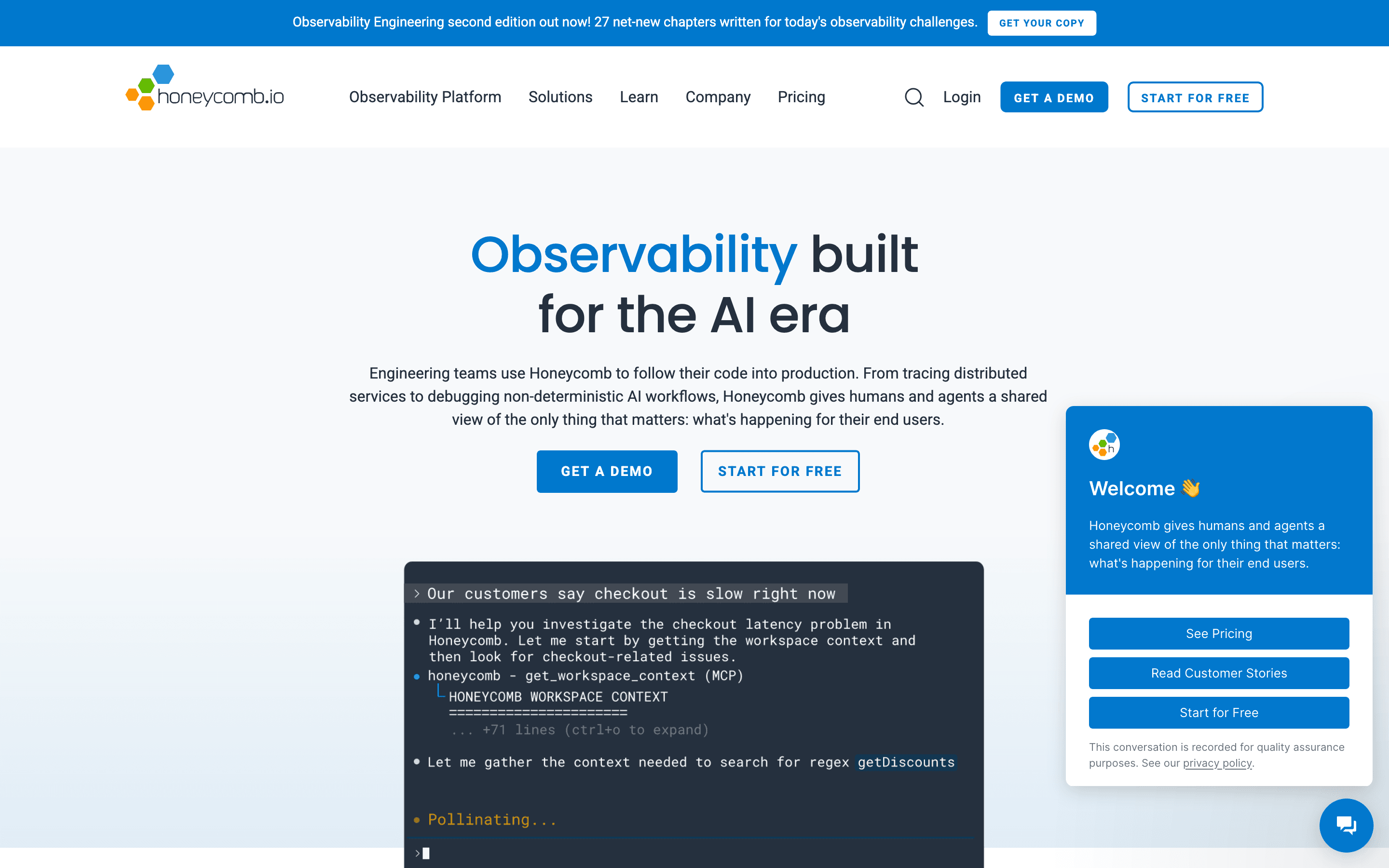
Honeycomb is built for the same job as Axiom: send it everything, don't pre-aggregate, and slice it however you need afterward, priced by event volume rather than seats. Its point of difference is BubbleUp, which highlights which fields differ in an anomaly automatically instead of making you build a query to find them, useful when a bug lives in the intersection of user ID, region, and build version. Honeycomb also moved early into AI agent tracing with Agent Timeline, now generally available, a use case Axiom is chasing with its own AI evaluation tooling. The tradeoff is price: Honeycomb's paid tier starts at $150 a month versus Axiom's $25, and anything past roughly 750 million events a month is quote-only.
Pros
- + BubbleUp finds the differentiating dimensions of an anomaly automatically instead of making you guess which graph to check next
- + Query latency stays fast even on very high-cardinality fields, which is the specific weakness of most metrics-first tools
- + Free tier is genuinely usable for small projects at 20M events and 100M metrics points a month
Cons
- – Bill scales with event volume, so a spike in trace volume or an unsampled deploy can jump your usage without any seat or infra change
- – Enterprise pricing is quote-only, so budgeting past Pro's ~750M events/month requires a sales conversation
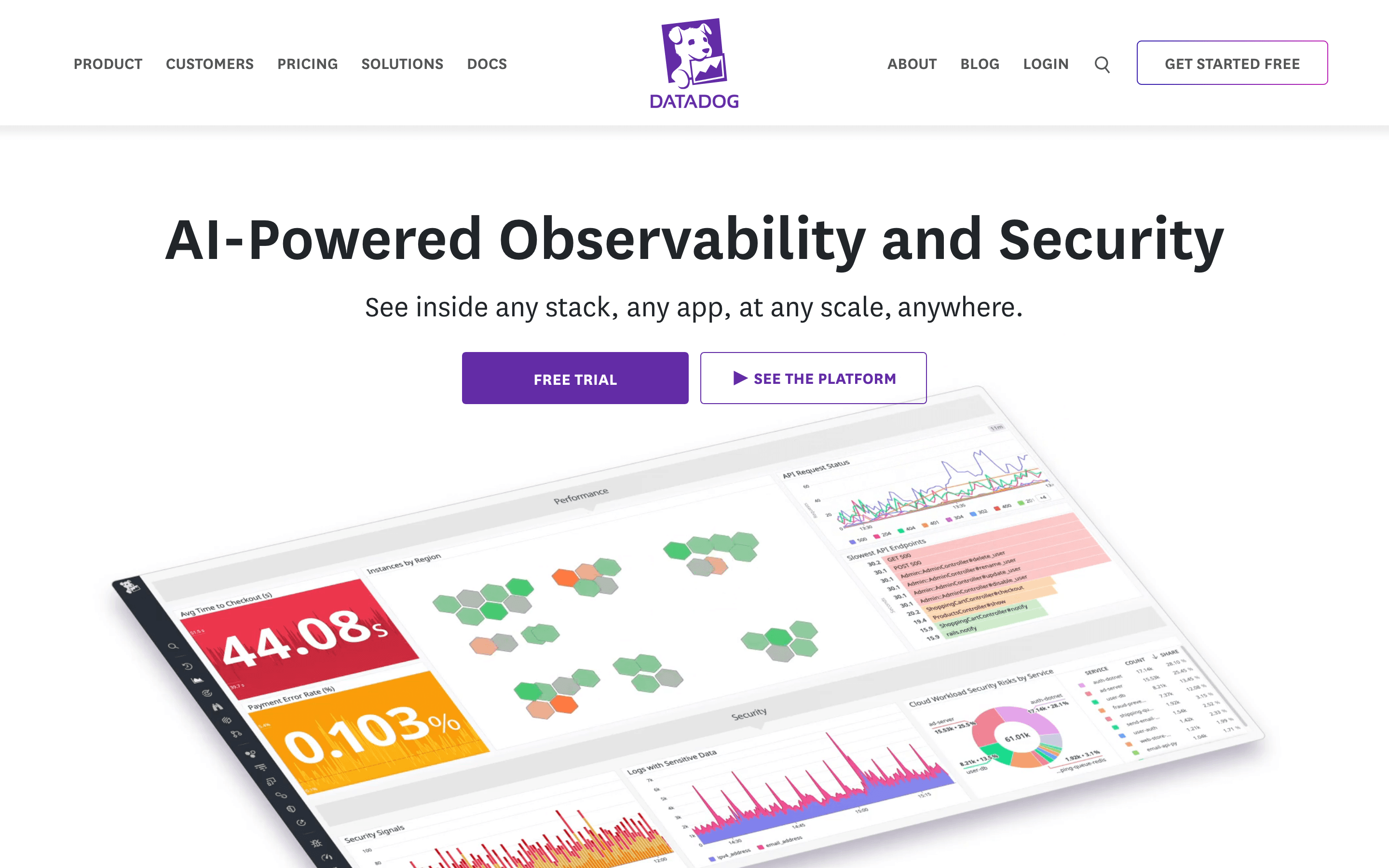
Datadog is the all-in-one alternative for teams who want infrastructure monitoring, APM, logs, RUM, and security under a single vendor instead of Axiom's narrower logs-traces-metrics focus. It ships 1,000+ integrations, so most cloud services plug in without custom work, and it's the incumbent choice once a company has grown past the stage where one engineer can own observability alone. The cost of that breadth is a bill split across many separately metered products, hosts, containers, custom metrics, log ingestion, log indexing, each with its own rate, so there's no single number that represents what a real deployment pays, unlike Axiom's simpler platform-fee-plus-credits model. Teams also have to watch custom metric cardinality and autoscaling host spikes closely, since Datadog's high-water-mark billing can lock in a whole month's charge from just a few days of extra load.
Pros
- + Covers infra, APM, logs, RUM, and security in one product with shared dashboards and one query language
- + 1,000+ integrations, so most cloud services and tools plug in without custom work
- + Free tier and 14-day trial with no credit card, so you can test it before committing
Cons
- – Pricing is split across many separately metered products (hosts, containers, custom metrics, log ingestion, log indexing), so the real bill is hard to predict from the pricing page alone
- – Host billing excludes only the top 1% of hourly readings each month, so a multi-day autoscaling spike, not just a brief one, can set the whole month's charge at that peak
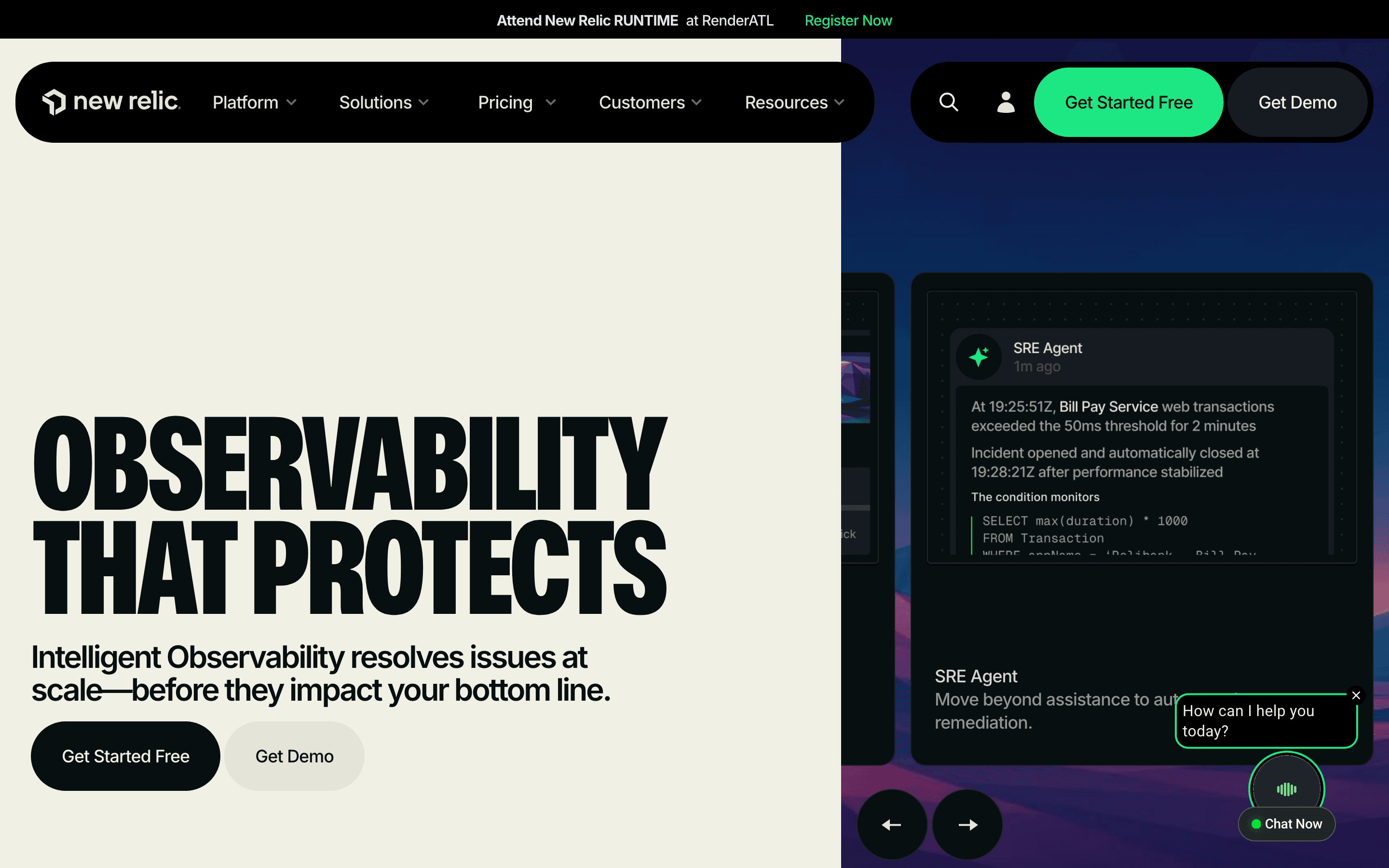
New Relic suits teams that want one platform for APM, infrastructure, logs, and traces and are prepared to pay for full incident-response access on a per-seat basis, a different cost model from Axiom's usage-only pricing. Its free tier, 100 GB ingest plus one full platform user, is a real starting point, and NRQL gives a genuine query language across every telemetry type. The catch is that the seats needed during an incident, the ones with APM and tracing access, cost $99 to $418.80 a month each, which pushes many teams to restrict access to a few licensed engineers and screen-share the rest. New Relic has also discontinued legacy pricing plans and moved some customers to new ones at renewal, with reported bills roughly doubling, a risk Axiom's simpler credit model doesn't carry in the same way.
Pros
- + One platform covers APM, infrastructure, logs, traces, and synthetics, so you're not paying for and maintaining separate tools
- + Genuinely useful free tier: 100 GB/month ingest and one full platform user, no credit card required
- + NRQL gives you a real query language across all your telemetry instead of a fixed set of dashboards
Cons
- – Full platform seats, the tier that unlocks APM and distributed tracing, cost $99-$418.80/month depending on plan, so giving your whole team incident access gets expensive fast
- – Engineers on cheaper Core or Basic seats can't see APM or tracing during an incident, which pushes teams toward screen-sharing with a licensed colleague
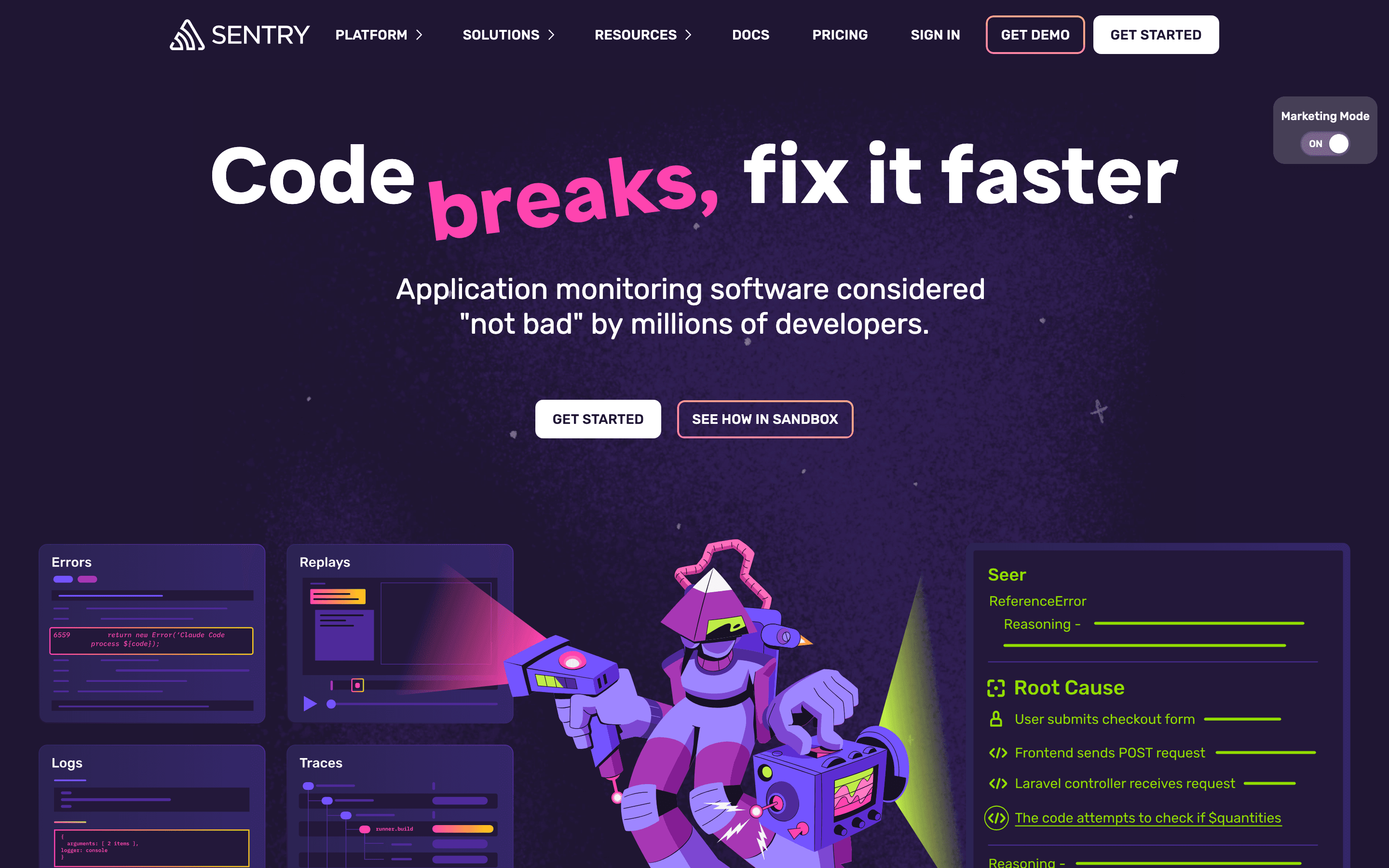
Sentry is the pick for teams whose real problem is catching exceptions and slow transactions tied to a specific release, not ingesting and querying huge volumes of raw logs, which is Axiom's core job. It ties every error to the commit that caused it, and its Seer AI agent can hand a proposed fix straight to GitHub Copilot, something no log-and-trace platform in this list does. Pricing is also usage-based, with a free Developer plan covering 5,000 errors and 5 million spans for one user. Where it falls short as an Axiom substitute is scale and scope: Sentry's overage rates on errors and spans roughly double between Team and Business tiers at high volume, and it isn't built to be the primary place you dump general application logs the way Axiom is.
Pros
- + Free Developer plan covers a real amount of usage (5k errors, 5M spans) for solo projects, not just a token trial
- + Every tier's data quota and every overage rate is published on the pricing page, so you can model cost before committing
- + Unlimited users on paid plans means adding teammates doesn't raise the bill
Cons
- – Usage-based billing means a bad deploy or a retry loop can spike your bill in a single day: one documented case put error overages alone at roughly $5,700/month plus $1,560 in span overages on top of the $80 Business base, at 20M errors and 500M spans a month
- – Business-tier overage rates for errors and spans run about double the Team-tier rate at the same volume (e.g. $0.0003 vs $0.00015 per error at the highest usage tier); replay overage is priced the same on both plans
Should your product be on this observability & error monitoring list?
If you build a tool that belongs next to the ones above, submit it. A human reviews every submission. Approved products get their own page with pricing and screenshots, plus a place in the comparisons where they fit. It is free. You sign in with your work email so you can follow the decision, and there is no password to create.
Axiom alternatives: FAQ
What is the cheapest Axiom alternative for a small team?+
Grafana Cloud's free tier covers 10,000 metric series and 50 GB each of logs, traces, and profiles a month, comparable to Axiom's own free allowance, and you can self-host the open source stack for free if you outgrow it.
Which Axiom alternative is best for tracing AI agents?+
Honeycomb's Agent Timeline, now generally available, gives a unified view of an agent's prompts, tool calls, and failures. Axiom is building similar AI evaluation tooling of its own, so the two are worth comparing directly if agent tracing is your main need.
Does any Axiom alternative offer flat, predictable pricing?+
Not really. Every tool on this list bills on some usage dimension, whether that's Datadog's per-host and per-GB meters, Grafana's per-series cardinality pricing, or Honeycomb's per-event pricing. New Relic comes closest with a flat per-seat price on Pro, but data overage still bills separately.
Why do teams leave Axiom for a dedicated APM tool?+
Axiom's metrics and dashboards are newer and thinner than what dedicated APM products like Datadog or New Relic offer, so teams that need mature distributed tracing and code-level performance monitoring often add or switch to one of those instead.
Axiom alternatives: pricing compared
Entry price, billing model, and whether pricing is public. 6 of 6 publish pricing you can check without talking to sales.
| Tool | Starting price | Billing | Free option | Pricing disclosed |
|---|---|---|---|---|
| Axiom | $25/mo | usage-based | Yes | Partly public |
| Grafana | $19/mo | usage-based | Yes | Partly public |
| Honeycomb | $150/mo | usage-based | Yes | Partly public |
| Datadog | $15/host/mo | usage-based | Yes | Partly public |
| New Relic | $10/seat/mo | tiered | Yes | Partly public |
| Sentry | $26/mo | usage-based | Yes | Partly public |
How we made these picks. We compare tools on public pricing, features, and hands-on assessment, then verify every price against the vendor's own page. We never accept payment for rankings. Read the full methodology. Spotted an error? Report it.